
How to Release Tight Hamstrings: Routine, Stretches and Strength
By the Rekup team · Published October 23, 2026 · 4 min read
To release tight hamstrings, roll the back of each thigh for 60 to 120 seconds, use a dynamic or gentle static stretch with a neutral back for 30 to 60 seconds, and strengthen them in a lengthened position with Romanian deadlifts and Nordic curls. Rolling and stretching improve range of motion for the day (Wilke et al., 2020; Behm et al., 2016). Eccentric strength is what makes the change last, and the Nordic hamstring curl halves hamstring injury rates in sport (van Dyk et al., 2019).
Three kinds of "tight hamstrings"
Before you stretch, work out which type you have:
| What you feel | Likely cause | What helps most |
|---|---|---|
| Diffuse stiffness that eases as you warm up | Normal training load, muscle tone | Rolling, mobility, strength at long lengths |
| Soreness 1 to 3 days after RDLs, sprints or hills | DOMS from eccentric work | Easy movement, light rolling, time |
| Pulling or tingling that gets worse when you bend forward with your chin to chest or flex your foot | Sensitive sciatic nerve | Nerve glides, avoiding aggressive stretching |
The third case is common in people who "stretch every day and are still tight". Aggressive stretching irritates a sensitive nerve further. If that's you, use the nerve glide in the routine below instead of long holds.
The 10-minute hamstring release routine
Foam rolling has no negative effect on performance (Wiewelhove et al., 2019), so steps 1 to 3 work well before a training session. Keep longer static holds for after training or separate mobility sessions (Behm et al., 2016).
Build hamstrings that stay loose
Tightness often means the hamstrings are guarding because they're weak at long lengths. Two exercises change that:
- Romanian deadlift, 3 × 8, lowering in 3 seconds, to where your back stays flat. 2 times a week.
- Nordic hamstring curl, 2 to 3 × 4 to 6, kneeling with your feet held, lowering your body as slowly as possible. Start with a band or a partial range. Including Nordics in training halves the rate of hamstring injuries (van Dyk et al., 2019).
Add them progressively: both cause soreness the first few times.
Common mistakes
- Rounding the back to touch your toes. That stretches the spine, not the hamstrings. Hinge from the hips.
- Stretching hard right before sprints. Use dynamic moves: leg swings, walking hamstring kicks.
- Stretching a fresh strain. If it started suddenly, rest it and get it checked.
- Only stretching. Without strength work, tightness returns.
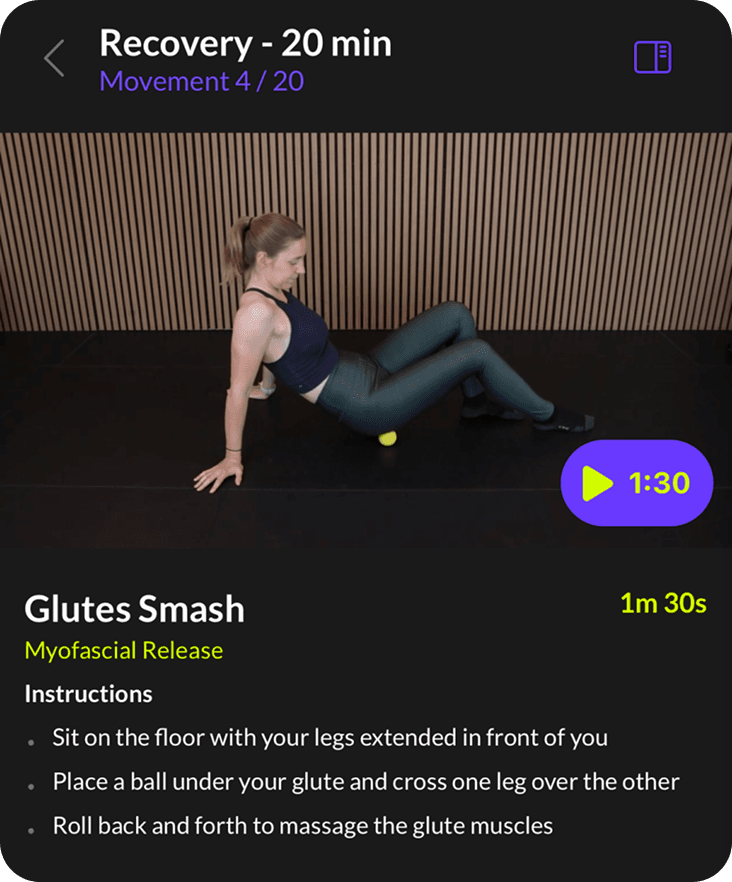
For the lower back side of the story, see lower back pain after deadlifts. For tight glutes, which often go with tight hamstrings, see the lacrosse ball glute and piriformis release.
In short
Roll the hamstrings, use active and hip-hinge stretches with a flat back, and switch to nerve glides if you feel tingling or pulling. Then build strength at long lengths with Romanian deadlifts and Nordic curls, which also halve your injury risk. 10 minutes a day for the release, twice a week for the strength.
Frequently asked questions
+Why are my hamstrings always tight even though I stretch?
Often the hamstrings aren't short but protective: they tighten when they lack strength at long lengths, when the pelvis tilts forward, or when the sciatic nerve is sensitive. Strength work in a lengthened position usually helps more than more stretching.
+Should I stretch tight hamstrings after deadlifts?
Gentle mobility is fine, but if they're sore from Romanian deadlifts or good mornings, they're already damaged by eccentric work. Use light rolling and easy movement, and save longer stretches for when the soreness has eased.
+How can I tell if my hamstring is strained, not just tight?
A strain usually starts suddenly during a sprint or a lift, with a sharp pain at a precise spot, sometimes bruising, and pain when you contract the muscle against resistance. Tightness is diffuse and improves with warming up.
+What is the best exercise for tight hamstrings?
For long-term change, eccentric exercises like the Nordic hamstring curl and Romanian deadlifts with a slow lowering phase. They improve strength at long muscle lengths and reduce hamstring injury risk.
+Can tight hamstrings cause lower back pain?
They can contribute by limiting how much your hips can bend, so your lower back rounds more when you pick something up or deadlift. They're rarely the only cause.
Get this routine built from your own training
Log your workouts and Rekup estimates the load on each muscle group, shows when each one is ready again, and builds a recovery routine for the muscles you actually trained, from more than 130 movements.
Try Rekup PRO free for 14 daysFree plan available. Cancel the trial anytime from the store.


This guide is educational and does not replace a diagnosis. If pain is severe, keeps getting worse or comes with the warning signs listed above, see a doctor or a physiotherapist.
Sources
- Behm DG et al. Acute effects of muscle stretching on physical performance, range of motion, and injury incidence: a systematic review. Applied Physiology, Nutrition, and Metabolism, 2016.
- Wilke J et al. Acute effects of foam rolling on range of motion in healthy adults: a systematic review with multilevel meta-analysis. Sports Medicine, 2020.
- van Dyk N et al. Including the Nordic hamstring exercise in injury prevention programmes halves the rate of hamstring injuries: a systematic review and meta-analysis. British Journal of Sports Medicine, 2019.
- Wiewelhove T et al. A meta-analysis of the effects of foam rolling on performance and recovery. Frontiers in Physiology, 2019.