
How to Foam Roll Your Quads: Technique, Time, Frequency
By the Rekup team · Published October 23, 2026 · 5 min read
To foam roll your quads, lie face down on the roller and slowly roll each zone of the thigh (centre, outside, inside and top) for 30 to 60 seconds, about 90 to 120 seconds per leg in total. Roll slowly, keep the pressure around 5 to 7 out of 10, and stay off the kneecap. Before a workout, keep it short; after a hard leg session, roll right after and on the next two days to reduce soreness.
What foam rolling actually does (and doesn't)
The research on foam rolling is more modest than social media suggests, but it is consistent. A 2019 meta-analysis found that rolling before exercise slightly improves flexibility and short sprint performance, and that rolling after exercise slightly reduces perceived muscle pain and the drop in performance in the following days (Wiewelhove et al., 2019). Done regularly over several weeks, it also improves range of motion (Konrad et al., 2022).
What it doesn't do: "break up" fascia or adhesions. The pressure you can create with your body weight is far too small to reshape connective tissue. The current explanation is mostly neurological: pressure changes how the nervous system perceives the muscle, which lowers tension and pain for a while. That is useful, but it also tells you how to roll: slowly and calmly, not as hard as possible. Why rolling works this way, and how long the effect lasts, is covered in what myofascial release really is.
The four zones of the quads
The quadriceps are four muscles. Rolling "the front of the thigh" misses half of them. Work through these zones on each leg:
| Zone | Where | How to position yourself |
|---|---|---|
| 1. Centre (rectus femoris) | Middle of the thigh, from just above the knee to the hip | Face down, both forearms on the floor, toes pointed down |
| 2. Outside (vastus lateralis) | Outer front of the thigh, in front of the seam of your pants | Rotate your body about 45° to the side being rolled |
| 3. Inside (vastus medialis) | The teardrop just above and inside the knee | Rotate the other way, leg slightly turned out, knee bent |
| 4. Top of the thigh / hip | The top of the quad up to the crease of the hip | Shift the roller up, keep the hip straight |
Step-by-step technique
The 90-second mark is not arbitrary: a systematic review on rolling duration found that range-of-motion benefits appear from roughly 90 to 120 seconds per muscle (Hughes & Ramer, 2019). Less than that is a warm-up, not a treatment.
Before training or after: what changes
Before a workout, keep it short: about 30 seconds per zone, at moderate pressure, then go straight into your warm-up. Short rolling does not reduce strength or power, and it can make the first squats feel smoother.
After a hard session, take your time: slower, longer on the sensitive spots, and repeat it the next two days. In a study where people did 100 squats at 60% of their max, rolling for 20 minutes immediately after, then at 24 and 48 hours, reduced tenderness and helped sprint and jump performance recover faster (Pearcey et al., 2015). Our guide on recovering from squats turns this into a full 72-hour plan, and how long muscles take to recover explains why the quads are among the slowest groups to come back.
Why it hurts, and how much is too much
Rolling quads after a hard session can be surprisingly painful. Sore muscles are more sensitive to pressure: that is the definition of DOMS. Pain on the roller does not mean you found something that needs to be "broken".
Use this scale:
- 3 to 4 out of 10: comfortable pressure. Good for warm-ups.
- 5 to 7 out of 10: the target zone. You can breathe calmly and keep your muscles relaxed.
- 8 out of 10 and above: too much. You tense up, hold your breath, and the muscle protects itself. Reduce the pressure by putting more weight on your forearms or the other leg, or use a softer roller.
The IT band and the knee
Most people roll the IT band, the thick band on the outside of the thigh, because it hurts so much it must be useful. It isn't very useful. The IT band is dense connective tissue, not muscle, and rolling on it won't lengthen it. If the outside of your thigh feels tight, roll zone 2 (the outer quad, just in front of the band) and the muscle at the front and side of the hip instead.
Same logic for the knee: roll up to a hand's width above the kneecap, never on it. If the front of the knee hurts when you climb stairs or squat, rolling the quads may relieve some tension, but persistent knee pain deserves a proper assessment.
In short
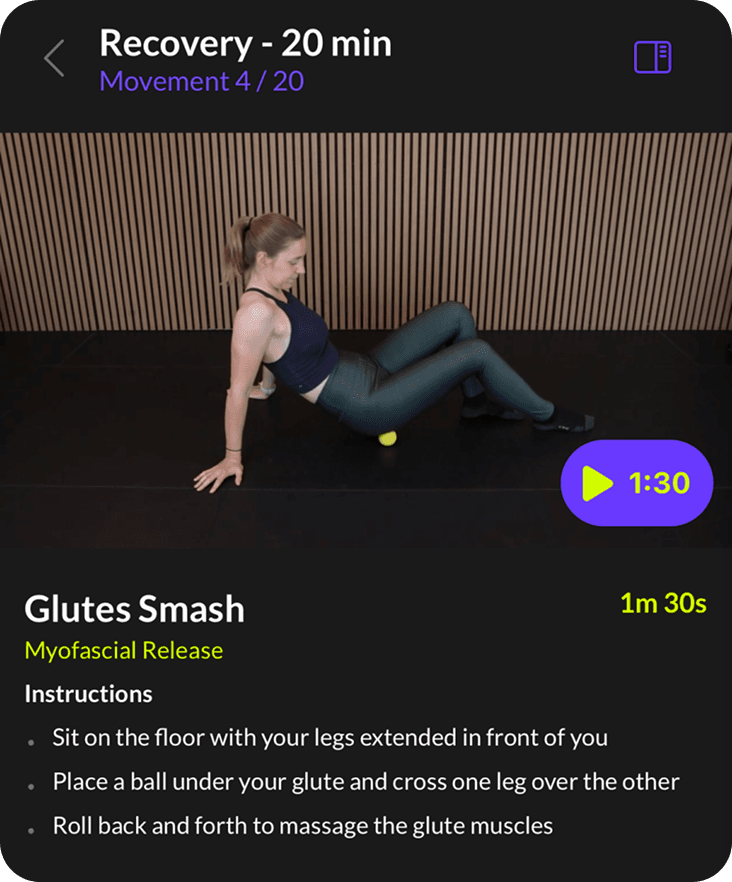
Roll all four zones of the quads, slowly, at a pressure you can breathe through, for about 90 to 120 seconds per leg. Keep it short before training and longer after hard leg sessions, repeating it on the following days. Leave the IT band and kneecap alone. If your glutes feel tight too, our guide to the lacrosse ball glute and piriformis release covers the area the roller struggles to reach.
Frequently asked questions
+How long should I foam roll my quads?
About 90 to 120 seconds per leg in total, split over the zones of the thigh, for range of motion and recovery. Before a workout, 30 seconds per zone is enough and won't reduce your performance.
+How often should I foam roll my quads?
Daily is fine. Rolling regularly over several weeks improves range of motion, and after a hard leg session, rolling right after and on the following two days helps soreness fade faster.
+Why is foam rolling my quads so painful?
Sore or heavily trained muscles are more sensitive to pressure. The pain is not fascia being broken up. Reduce pressure by putting more weight on your hands or the other leg, and stay around 5 to 7 out of 10.
+Should I foam roll my IT band?
Rolling directly on the IT band is very painful and does little, because it is a thick band of connective tissue that won't lengthen. Roll the outer quad just in front of it and the muscle at the front of the hip instead.
+Can foam rolling quads help knee pain?
Rolling the quads can make the front of the knee feel less tight, but never roll over the kneecap or the joint itself. Knee pain with swelling, locking or instability needs a physiotherapist, not a roller.
Get this routine built from your own training
Log your workouts and Rekup estimates the load on each muscle group, shows when each one is ready again, and builds a recovery routine for the muscles you actually trained, from more than 130 movements.
Try Rekup PRO free for 14 daysFree plan available. Cancel the trial anytime from the store.


This guide is educational and does not replace a diagnosis. If pain is severe, keeps getting worse or comes with the warning signs listed above, see a doctor or a physiotherapist.
Sources
- Wiewelhove T et al. A meta-analysis of the effects of foam rolling on performance and recovery. Frontiers in Physiology, 2019.
- Hughes GA, Ramer LM. Duration of myofascial rolling for optimal recovery, range of motion, and performance. International Journal of Sports Physical Therapy, 2019.
- Konrad A et al. Foam rolling training effects on range of motion: a systematic review and meta-analysis. Sports Medicine, 2022.
- Pearcey GE et al. Foam rolling for delayed-onset muscle soreness and recovery of dynamic performance measures. Journal of Athletic Training, 2015.