
How to Recover From Squats and Heavy Leg Day
By the Rekup team · Updated November 2, 2026 · 7 min read
To recover from squats, keep moving lightly, roll your quads, glutes and adductors once a day for two to three days, eat enough protein and sleep. Most people are recovered within 48 to 72 hours, and squatting again lightly at 48 hours is usually fine. Soreness in the front of the thighs, the glutes or the inner thighs is normal; pain inside the knee or a sharp pain in the lower back is not.
Where squats should make you sore, and where they shouldn't
The squat loads a lot of muscle, and most of the soreness comes from the lowering phase: your quads and glutes control the descent while they lengthen, which is the type of work that creates the most delayed soreness. Use this map to read what you feel the next day:
| Where it hurts | What it usually means |
|---|---|
| Front of the thighs (quads), worse on stairs | Normal DOMS. The most common after squats. |
| Glutes, worse when you sit down | Normal DOMS, typical after deep squats. |
| Inner thighs (adductors) | Normal, especially with a wide stance or deep low-bar squats. |
| Hamstrings | Possible, mild. More common after Romanian deadlifts the same day. |
| Lower back, diffuse muscular ache | Your back muscles worked to hold position. Fine if mild and symmetrical. |
| Lower back, sharp or one-sided | Not DOMS. See our guide on lower back pain after deadlifts, which applies to squats too. |
| Inside the knee joint | Not DOMS. Check the warning box below. |
The 72-hour squat recovery protocol
This protocol is built on a study that is unusually close to real leg day: participants did 10 sets of 10 back squats at 60% of their max, then foam rolled their legs for 20 minutes right after, and again at 24 and 48 hours. Compared with the group who didn't roll, they reported less muscle tenderness and recovered sprint speed and broad jump faster (Pearcey et al., 2015).
Mobility that actually helps after squats
You don't need a long stretching session. Stretching does little for soreness itself. Two short drills help most people feel better and squat better on the next session:
- Ankle dorsiflexion: knee-to-wall rocks, 2 sets of 10 per side. Stiff ankles push the stress forward onto the knees and make you lean.
- Hip flexor opener: half-kneeling position, squeeze the glute of the back leg and shift forward gently, 2 times 30 seconds per side. Useful after a lot of deep squatting and sitting.
Keep these to a few minutes. Their job is to restore your usual range, not to chase new flexibility while you are sore.
Knee pain after squats and lunges
Knee pain after squats and lunges is most often felt at the front of the knee, around or behind the kneecap, and it usually comes from doing more deep knee bending than the knee is used to, not from damage. Ache that eases as you warm up is a load problem you can manage. Swelling, locking, giving way or pain inside the joint is not, and needs a physiotherapist.
Where it hurts tells you what to adjust
| Where you feel it | What it usually is | What to change |
|---|---|---|
| Above the kneecap, in the muscle | Quad soreness (DOMS) | Nothing special: follow the 72-hour protocol above |
| Around or behind the kneecap, worse on stairs or after sitting | Patellofemoral irritation | Less deep knee bending for 1 to 2 weeks, then build back |
| Just below the kneecap, on the tendon | Patellar tendon irritation, common with jumps and deep loaded squats | Cut jumps and jumping lunges first, keep slow strength work |
| Inside the joint, with swelling or locking | Not a load problem | Stop and get it assessed |
Why lunges hurt the knee more than squats
In a lunge, the front leg carries most of your weight on its own, and the front knee often travels well forward at the bottom. The compression between the kneecap and the thigh bone rises as the knee bends deeper under load (Escamilla, 2001), so a session of walking lunges after heavy squats piles a lot of that deep-flexion work onto the same joint. That is why the knee often complains after the lunges, not after the squats themselves.
What to do for the next one to two weeks
- Keep training, change the range. Squat to the depth you can reach without pain going above about 3 out of 10, for example to a box, and lower the box progressively as it settles. This is temporary, not a new squat standard.
- Swap the lunge variation. Replace walking or jumping lunges with slower reverse lunges or split squats, which let you control how far the knee travels forward.
- Strengthen the hips as well as the quads. For front-of-knee pain, the international consensus recommends exercise therapy that combines hip and knee strengthening (Crossley et al., 2016). Side-lying or banded hip abduction and glute bridges, 3 sets of 12 to 15, on non-squat days are a simple start.
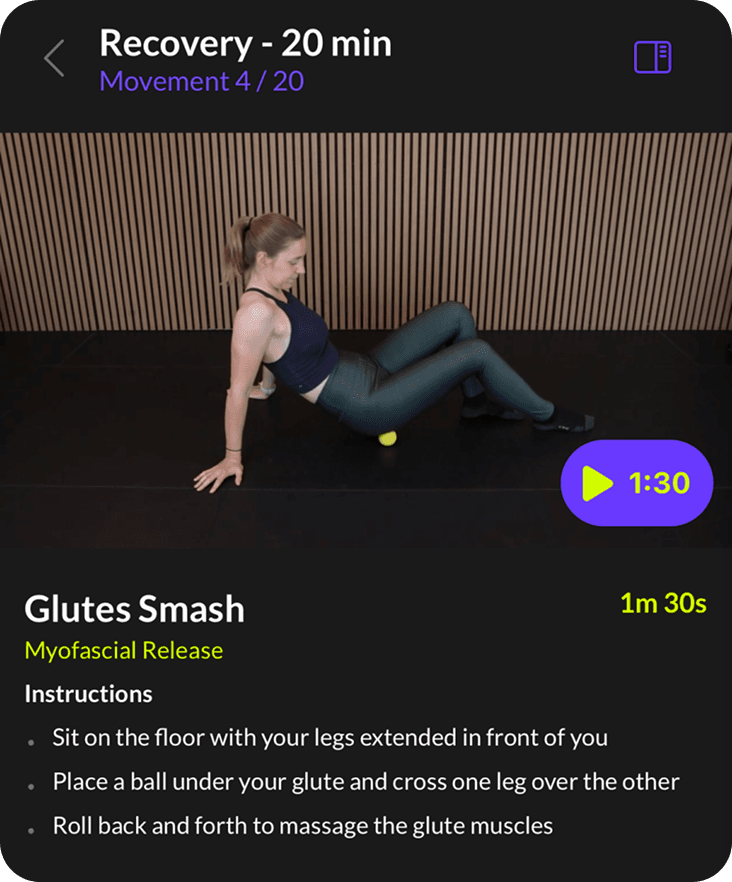
- Roll the thigh, not the knee. Roll the quads and the outer thigh up to a hand's width above the kneecap. Never roll on the kneecap or the joint.
If the pain stays above 3 out of 10 during your warm-up after two weeks of these changes, see a physiotherapist rather than waiting it out.
Planning squats so leg day hurts less
The worst leg days are rarely the heaviest. They are the ones that come after a break, or the ones that stack something new on top of something hard. Three habits change that:
- Squat regularly. One session of unfamiliar eccentric work protects the muscle against the same work for several weeks (McHugh, 2003). Squatting once or twice a week keeps you in that protected state.
- Add volume progressively. If you take a two-week break, don't come back with your old volume. Start around half and build back up over two to three weeks.
- Watch the extras. Slow tempo squats, pause squats, walking lunges and jumping lunges after your main lift all multiply soreness. Choose one, not all three, in the same session.
How the next squat session should feel
A useful check before loading the bar again: do a few sets of empty-bar squats. If your depth is normal, your knees track the way they usually do and the soreness fades as you warm up, you are good to train. If soreness gets worse as you warm up, or you can't reach your usual depth, give it another day and train upper body.
Key takeaways
Squats make your quads, glutes and adductors sore because of the controlled lowering, and that soreness peaks around day two. Roll those muscles right after, at 24 and at 48 hours, move lightly in between, eat enough protein and sleep enough for your muscles to repair. Squat again lightly at 48 hours, and squat regularly so your legs stay adapted. For a broader look at soreness from any session, read how to get rid of DOMS.
Frequently asked questions
+How long does it take to recover from squats?
For a normal heavy session, most people feel recovered in 48 to 72 hours. After a session with a lot of new volume, tempo squats or lunges on top, soreness can last four to five days. Squatting again lightly at 48 hours is usually fine.
+Why are my inner thighs sore after squats?
Your adductors work hard in a deep squat, especially with a wider stance. Soreness there is normal muscle soreness, as long as it is symmetrical and not a sharp pain in the groin.
+Should I squat with sore legs?
Light squats through full range often reduce stiffness. Avoid going heavy while the soreness still changes your depth or bar path, because sore muscles are temporarily weaker.
+Is it normal for my knees to hurt after squats?
Muscle soreness above the knee in the quads is normal. Pain inside the joint, swelling, clicking with pain, locking or a feeling that the knee gives way is not DOMS and should be checked by a physiotherapist.
+How often should I squat to be less sore?
Squatting at least once a week, ideally twice, keeps the protective effect of regular training. Most painful leg days come after a break or a sudden jump in volume.
Get this routine built from your own training
Log your workouts and Rekup estimates the load on each muscle group, shows when each one is ready again, and builds a recovery routine for the muscles you actually trained, from more than 130 movements.
Try Rekup PRO free for 14 daysFree plan available. Cancel the trial anytime from the store.


This guide is educational and does not replace a diagnosis. If pain is severe, keeps getting worse or comes with the warning signs listed above, see a doctor or a physiotherapist.
Sources
- Pearcey GE et al. Foam rolling for delayed-onset muscle soreness and recovery of dynamic performance measures. Journal of Athletic Training, 2015.
- Dupuy O et al. An evidence-based approach for choosing post-exercise recovery techniques. Frontiers in Physiology, 2018.
- McHugh MP. Recent advances in the understanding of the repeated bout effect. Scandinavian Journal of Medicine & Science in Sports, 2003.
- Morton RW et al. A systematic review, meta-analysis and meta-regression of the effect of protein supplementation on resistance training-induced gains. British Journal of Sports Medicine, 2018.
- Hughes GA, Ramer LM. Duration of myofascial rolling for optimal recovery, range of motion, and performance. International Journal of Sports Physical Therapy, 2019.
- Escamilla RF. Knee biomechanics of the dynamic squat exercise. Medicine & Science in Sports & Exercise, 2001.
- Crossley KM et al. 2016 Patellofemoral pain consensus statement from the 4th International Patellofemoral Pain Research Retreat, Manchester. Part 2: recommended physical interventions. British Journal of Sports Medicine, 2016.