
How to Get Rid of DOMS: What Actually Works
By the Rekup team · Published October 23, 2026 · 5 min read
You can't make DOMS (delayed onset muscle soreness) disappear overnight, but you can make it shorter and easier to train through. The methods with the best evidence are massage, foam rolling and compression, combined with light movement, enough protein and a full night of sleep. Stretching after a workout and most gadgets do very little. DOMS peaks 24 to 72 hours after a hard session and fades on its own within five to seven days.
What DOMS actually is
DOMS is the dull, tender ache that shows up the day after a session, gets worse on day two, and makes stairs feel like a punishment. It comes from small disruptions in muscle fibres, followed by inflammation and a temporary sensitisation of the nerves in the area. That is why it is delayed: the pain tracks the repair process, not the workout itself.
Three things make it worse:
- Eccentric work: any movement where the muscle lengthens under load. The lowering phase of a squat, walking lunges, downhill running, the descent of a box jump, slow negatives.
- Novelty: a movement you haven't done for weeks, or a new range of motion.
- Volume: 100 wall balls or a high-rep chipper will leave marks even if each rep is light.
Lactic acid is not the cause. Lactate is cleared within roughly an hour after exercise, long before soreness starts.
What reduces soreness, ranked by evidence
A 2018 meta-analysis compared the main recovery techniques on soreness, fatigue and markers of muscle damage (Dupuy et al.). Here is what the research supports, in practical terms:
| Method | Effect on DOMS | Worth it? |
|---|---|---|
| Massage | The largest and most consistent effect on soreness and perceived fatigue | Yes, if you have access to it |
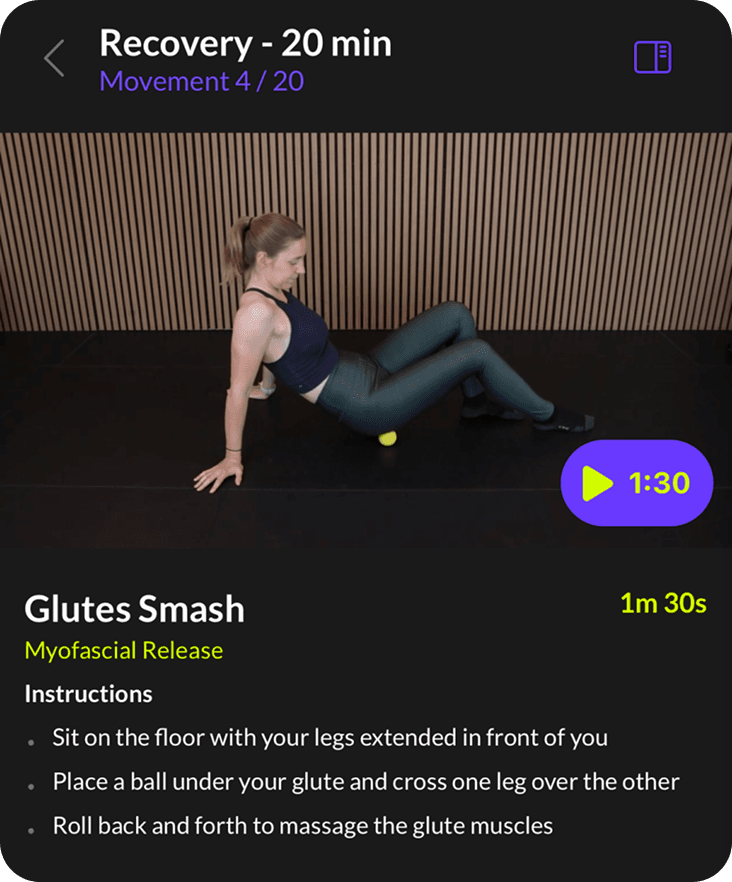
| Foam rolling / self-massage | Small but real reduction in perceived pain | Yes: cheap, can be done daily |
| Compression garments | Modest benefit on soreness and strength recovery | Optional, useful for travel and races |
| Cold water immersion | Reduces soreness short term | Only around competitions (see below) |
| Light active recovery | Helps you feel less stiff; modest effect on soreness itself | Yes |
| Stretching | Negligible effect on soreness | Not for DOMS |
| Sleep and protein | Do not mask pain, but support the repair that ends it | Non-negotiable |
The pattern is clear: anything that applies pressure to the muscle (massage, rolling, compression) works better than anything that lengthens it. In a study on squats, 20 minutes of foam rolling right after training and again at 24 and 48 hours reduced muscle tenderness and helped sprint and jump performance recover compared with doing nothing (Pearcey et al., 2015). The effect is not huge, but it is consistent, and it costs nothing. If you want the technique, our guide on how to foam roll your quads goes through it zone by zone, and what myofascial release actually does explains why the effect is real but short-lived.
A day-by-day protocol
Cold water: useful, but not after every session
Ice baths and cold showers do reduce soreness in the short term. The catch is that, used routinely after strength training, they blunt the gains you train for: in a 12-week study, athletes who did cold water immersion after their sessions gained less muscle and strength than those who did active recovery (Roberts et al., 2015).
So keep cold water for situations where tomorrow's performance matters more than long-term adaptation: a competition weekend, a Hyrox race, the CrossFit Open, two sessions in one day. After a regular training session, skip it.
Should you train with DOMS?
Usually yes, with judgement. Soreness itself is not damage you are making worse, but sore muscles are temporarily weaker and less coordinated, so heavy lifting with them carries more risk and less benefit.
A practical rule: if the soreness changes the way you move (you shorten your squat depth, you limp, you compensate), that muscle group isn't ready for load. Train something else, or keep it to easy, full-range work.
How to get less sore next time
The best long-term fix is the repeated bout effect: after one session of unfamiliar eccentric work, muscles are much better protected against damage from the same work for several weeks (McHugh, 2003). In practice:
- Introduce new movements and high-volume eccentric work progressively, especially after a break.
- Train a movement pattern at least once a week rather than in rare, brutal doses. Twice a week of moderate lunges hurts less than one session of 200.
- Be careful with novelty stacked on volume: a new movement inside a long WOD is the classic recipe for a week of stairs-avoidance.
The bottom line
DOMS is a normal response to new or eccentric work, not a measure of how good the session was. Shorten it with pressure (massage, rolling, compression), light movement, protein and sleep. Save cold water for competition days. And prevent most of it by building volume progressively instead of in shocks. If the soreness comes from leg day, our guide on recovering from squats has a protocol built for that specific session.
Frequently asked questions
+How long does DOMS last?
Soreness usually appears 12 to 24 hours after the session, peaks between 24 and 72 hours, and is gone within five to seven days. If it is still severe after a week, it is probably not simple DOMS.
+Is DOMS a sign of a good workout?
No. DOMS mostly reflects how new or how eccentric the work was, not how much you will progress. Athletes who train a movement regularly get less sore from it while still getting stronger.
+Should I train when I have DOMS?
Yes, lightly. Easy cardio and training other muscle groups are fine and often make you feel better. Avoid heavy or very eccentric work for the sorest muscles until the peak has passed, because strength is temporarily reduced.
+Does lactic acid cause muscle soreness?
No. Lactate is cleared from the blood within about an hour after exercise. DOMS comes from micro-damage to muscle fibres and the inflammation and nerve sensitisation that follow, which is why it shows up a day later.
+Does stretching get rid of DOMS?
Barely. A Cochrane review found that stretching before or after exercise reduces soreness by a few points on a 100-point scale, too little to notice. Stretch for mobility if you like it, not to treat soreness.
Get this routine built from your own training
Log your workouts and Rekup estimates the load on each muscle group, shows when each one is ready again, and builds a recovery routine for the muscles you actually trained, from more than 130 movements.
Try Rekup PRO free for 14 daysFree plan available. Cancel the trial anytime from the store.


This guide is educational and does not replace a diagnosis. If pain is severe, keeps getting worse or comes with the warning signs listed above, see a doctor or a physiotherapist.
Sources
- Cheung K, Hume P, Maxwell L. Delayed onset muscle soreness: treatment strategies and performance factors. Sports Medicine, 2003.
- Dupuy O et al. An evidence-based approach for choosing post-exercise recovery techniques. Frontiers in Physiology, 2018.
- Herbert RD, de Noronha M, Kamper SJ. Stretching to prevent or reduce muscle soreness after exercise. Cochrane Database of Systematic Reviews, 2011.
- Wiewelhove T et al. A meta-analysis of the effects of foam rolling on performance and recovery. Frontiers in Physiology, 2019.
- Pearcey GE et al. Foam rolling for delayed-onset muscle soreness and recovery of dynamic performance measures. Journal of Athletic Training, 2015.
- Brown F et al. Compression garments and recovery from exercise: a meta-analysis. Sports Medicine, 2017.
- Roberts LA et al. Post-exercise cold water immersion attenuates acute anabolic signalling and long-term adaptations in muscle to strength training. Journal of Physiology, 2015.
- McHugh MP. Recent advances in the understanding of the repeated bout effect. Scandinavian Journal of Medicine & Science in Sports, 2003.
- Fullagar HH et al. Sleep and athletic performance. Sports Medicine, 2015.
- MedlinePlus. Rhabdomyolysis.