
How Long Do Muscles Take to Recover? Recovery Time by Muscle Group
By the Rekup team · Published November 19, 2026 · 8 min read
Most muscles need 48 to 72 hours to recover from a hard session. Big muscle groups worked with heavy, eccentric-heavy lifts (quads, glutes, hamstrings, back) sit at the long end and sometimes need longer. Smaller muscles (biceps, triceps, calves, forearms) often recover in 24 to 48 hours. What changes the answer most is not the muscle, but how close to failure you trained and how much eccentric work the session contained.
Recovery time by muscle group
The table below gives working ranges after a hard session for that muscle, meaning several working sets close to failure. They are estimates built from the studies cited in this guide and from how training load is usually programmed, not lab values for each muscle: no study has measured every muscle group under the same conditions.
| Muscle group | Typical recovery after a hard session | What makes it longer |
|---|---|---|
| Quads | 48 to 72 h, up to 96 h | Deep squats, lunges, wall balls, downhill running |
| Hamstrings and glutes | 48 to 72 h, up to 96 h | Romanian deadlifts, Nordic curls, sprinting |
| Lower back | 48 to 72 h | Heavy deadlifts, cleans, high-rep kettlebell swings |
| Upper back and lats | 48 to 72 h | Heavy rows, high-volume pull-ups, rowing machine |
| Chest | 48 to 72 h | Heavy bench to failure, high-rep push-ups or dips |
| Shoulders | 48 h | Overhead pressing, handstand work, wall balls |
| Biceps, triceps, forearms | 24 to 48 h | Pull-up volume, toes-to-bar, grip-heavy sessions |
| Calves | 24 to 48 h | Jumping, skipping, running on top of strength work |
| Core | 24 to 48 h | Long sets of sit-ups or toes-to-bar |
Two findings support the shape of this table. In a study comparing exercises, multi-joint lifts caused a larger drop in repetitions 24 hours later than single-joint lifts (Korak et al., 2015). And after the CrossFit benchmark Karen, 150 wall balls, trained men rated their lower-body recovery far lower than their upper-body recovery at 24 hours (Frontiers in Physiology, 2022). The big, multi-joint, leg-dominant work is what takes longest.
What changes how long a muscle takes to recover
Recovery time is a dose-response: the harder and more unfamiliar the session, the longer it takes. Four factors explain most of the difference between "fine the next day" and "still flat three days later".
1. How close to failure you went
This is the biggest lever you control. In a study of trained men doing bench press and squats, sets taken to failure caused a much larger drop in jump height and bar speed than matched sets stopped halfway, and recovery from the non-failure sessions was significantly faster between 24 and 48 hours (Morán-Navarro et al., 2017). Stopping two or three reps short of failure on most sets often saves you a full day of recovery for very little loss of stimulus.
2. How much eccentric work there was
Eccentric work, the lowering phase of a lift, landing from a jump or running downhill, causes most of the muscle damage that keeps strength down for days. A review of eccentric-exercise research notes that typical resistance training and downhill running cause mild damage with full recovery within a few days, while extreme, unaccustomed eccentric work can take more than a week (Paulsen et al., 2012). This is why a first session of Nordic curls or a hilly trail race leaves you wrecked far longer than the same time spent cycling.
3. How new the movement is
The first time you do a movement, or the first time after a long break, recovery takes much longer. The second exposure a week or two later causes less damage and soreness for the same work, an adaptation called the repeated bout effect (McHugh, 2003). Practically: the first week of a new program or a return to training is not the time to judge how fast you recover.
4. Everything outside the gym
Sleep, total food intake, protein and stress all draw on the same recovery capacity. A week of short nights can add a day to every recovery window in the table. Our guide on sleep and muscle recovery explains why sleep has the strongest evidence of any recovery method.
Soreness is not a reliable recovery signal
Many athletes wait until a muscle stops being sore before training it hard again. That is a reasonable rule of thumb, but soreness and recovery are not the same thing. In a study of 110 people doing different volumes of eccentric arm work, soreness correlated only weakly with the loss of strength and other markers of damage (Nosaka et al., 2002). You can be sore with strength nearly back, or barely sore with strength still well below normal.
So soreness tells you something, but not enough. What matters is whether the muscle can produce force and move through its full range again. More on what soreness actually is in our guide to getting rid of DOMS.
How to know if a muscle is recovered: a 3-check test
Use these three checks before a hard session for a muscle you trained recently. They are practical field checks, not validated tests, but together they catch most "not ready yet" days.
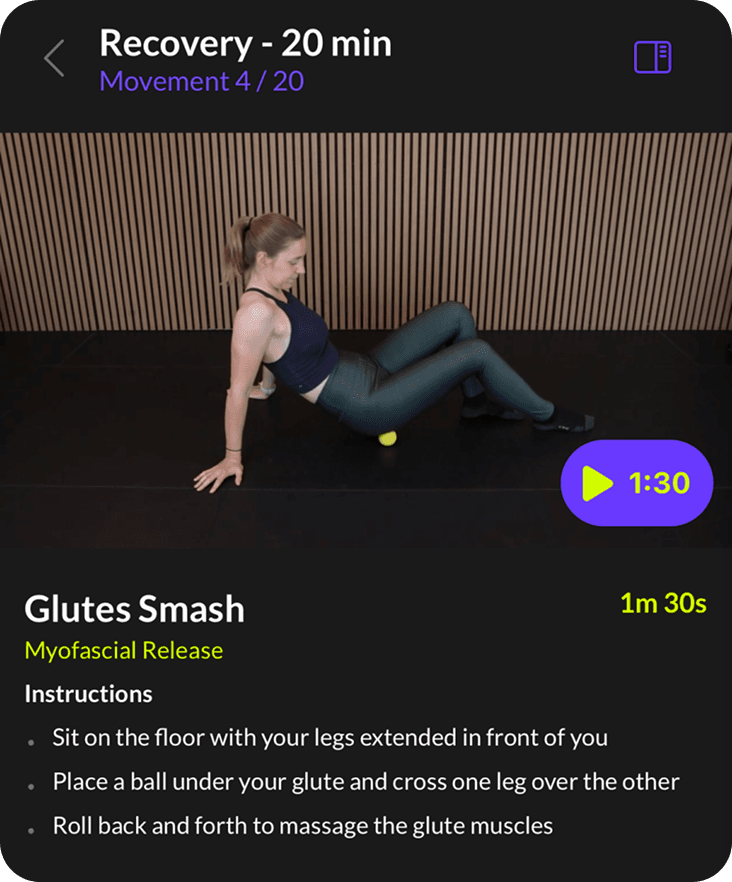
Recovery work does not make a muscle recover faster in a meaningful way, but it can make it feel better and move better in the meantime. A short routine on the muscles that are still loaded, light foam rolling or a ball for 60 to 90 seconds per area followed by a few minutes of mobility work, is a good use of a day off. Our guide on what myofascial release actually does covers why the effect is real but short-term, and how to recover faster between workouts ranks the methods by evidence.
How to plan your week so muscles recover
You don't need to rest every muscle for three days. You need to avoid hitting the same muscle hard before it is back. Three ways to do that:
- Rotate the hard days. Train legs hard, upper body hard the next day, then easier full-body work. Each muscle gets 48 to 72 hours between hard exposures while you still train often.
- Alternate heavy and light for the same muscle. If you squat twice a week, make one session heavy and the other lighter or with fewer sets. A meta-analysis found that training a muscle about twice a week tends to produce more growth than once a week (Schoenfeld et al., 2016), so frequency is worth keeping; it just should not be maximal every time.
- Count conditioning as load. Wall balls, box jumps, running and rowing all load the legs and back. A strength day followed by a leg-heavy metcon is two leg sessions, not one. Our guides on recovering from CrossFit and Hyrox recovery show how to arrange this in those sports.
If you have planned well and muscles still never feel recovered week after week, the problem is no longer a 48-hour window. It may be accumulated fatigue, which a lighter week fixes; see our guides on the deload week and on how long overtraining lasts.
The bottom line
Plan for 48 to 72 hours between hard sessions for the same muscle, more for heavy, eccentric leg and back work, less for arms and calves. Stop most sets short of failure if you want to train a muscle more often. And before you load a muscle again, check range, soreness in movement and how your warm-up sets feel, rather than relying on soreness alone.
Frequently asked questions
+Can you train the same muscle two days in a row?
Yes, if the first session was light or the second one is. Two hard sessions for the same muscle on consecutive days mostly add fatigue: after sets taken to failure, strength and power are often still down at 24 to 48 hours. Hit a muscle hard, then train it lightly or train something else the next day.
+Is it bad to work out a sore muscle?
Light, full-range work on a mildly sore muscle is fine and often makes it feel better. Heavy or explosive work on a muscle that is still sore enough to change the way you move is where the risk sits: the muscle is weaker and less coordinated than usual. Soreness that makes you limp or shorten your range is a clear 'not yet'.
+Do muscles grow on rest days?
Training is the signal; the adaptation happens in the hours and days that follow, so recovery time is when the work pays off. Rest days matter because they let you train the next session hard. That does not mean more rest equals more growth: training each muscle about twice a week tends to beat once a week.
+Why do my legs take longer to recover than my arms?
Leg training usually involves more muscle mass, heavier loads, more eccentric work (lowering into squats and lunges) and often running or jumping on top. In a study of the CrossFit workout Karen, 150 wall balls, perceived lower-body recovery dropped far more than upper-body recovery 24 hours later. The muscle itself is not slower; the dose is bigger.
+Does age change how long recovery takes?
Older athletes often report needing more time between hard sessions, and the usual advice is to add a day for the biggest sessions and watch how you respond. The research on age and recovery speed is mixed, and training history matters a lot: a fit 50-year-old who has trained for years can recover faster than an untrained 25-year-old.
Get this routine built from your own training
Log your workouts and Rekup estimates the load on each muscle group, shows when each one is ready again, and builds a recovery routine for the muscles you actually trained, from more than 130 movements.
Try Rekup PRO free for 14 daysFree plan available. Cancel the trial anytime from the store.


This guide is educational and does not replace a diagnosis. If pain is severe, keeps getting worse or comes with the warning signs listed above, see a doctor or a physiotherapist.
Sources
- Morán-Navarro R et al. Time course of recovery following resistance training leading or not to failure. European Journal of Applied Physiology, 2017.
- Korak JA, Green JM, O'Neal EK. Resistance training recovery: considerations for single vs. multi-joint movements and upper vs. lower body muscles. International Journal of Exercise Science, 2015.
- Time course of recovery following CrossFit Karen benchmark workout in trained men. Frontiers in Physiology, 2022.
- Paulsen G, Mikkelsen UR, Raastad T, Peake JM. Leucocytes, cytokines and satellite cells: what role do they play in muscle damage and regeneration following eccentric exercise? Exercise Immunology Review, 2012.
- Nosaka K, Newton M, Sacco P. Delayed-onset muscle soreness does not reflect the magnitude of eccentric exercise-induced muscle damage. Scandinavian Journal of Medicine & Science in Sports, 2002.
- McHugh MP. Recent advances in the understanding of the repeated bout effect: the protective effect against muscle damage from a single bout of eccentric exercise. Scandinavian Journal of Medicine & Science in Sports, 2003.
- Schoenfeld BJ, Ogborn D, Krieger JW. Effects of resistance training frequency on measures of muscle hypertrophy: a systematic review and meta-analysis. Sports Medicine, 2016.