
Sleep and Muscle Recovery: How Much You Need and How to Use It
By the Rekup team · Published October 30, 2026 · 7 min read
Sleep is when your muscles do most of their repair, and losing it measurably slows that repair. In a controlled study, one night without sleep reduced muscle protein synthesis by 18% the following day (Lamon et al., 2021), and five nights of 4 hours in bed lowered it too (Saner et al., 2020). Adults need 7 to 9 hours; if you train hard, aim for the top of that range and protect your sleep most on heavy days.
How sleep repairs your muscles
Training damages muscle fibres; recovery is the process that rebuilds them, mostly by making new muscle proteins. That process, muscle protein synthesis, runs around the clock, and sleep changes the conditions it runs in.
Lamon and colleagues kept 13 young adults (seven men, six women) awake for one full night and compared them with a normal night, in a randomised cross-over design. After the sleepless night, muscle protein synthesis was 18% lower, cortisol (a catabolic hormone) was 21% higher, and testosterone 24% lower. The authors describe the result as "anabolic resistance": the same muscle responds less to the signals that build it.
Shorter nights do something similar over time. In Saner's study, young men spent five nights with only 4 hours in bed; their myofibrillar protein synthesis (the contractile proteins that produce force) was lower than in the group sleeping 8 hours. One detail matters for athletes: the group that did high-intensity interval training during the same five nights kept their protein synthesis at control levels. Training did not make sleep loss harmful; it partly protected against it.
A third mechanism is often quoted: growth hormone is released mostly during deep, slow-wave sleep. It is a plausible piece of the picture, but the link between sleep hormones and muscle recovery was proposed as a hypothesis (Dattilo et al., 2011) and has not been quantified in athletes as clearly as protein synthesis has.
| What happens | Evidence | Strength |
|---|---|---|
| One night without sleep lowers muscle protein synthesis by 18% | Lamon et al., 2021, randomised cross-over, 13 participants | Good, but small sample and total sleep loss |
| Five nights of 4 h in bed lower myofibrillar protein synthesis | Saner et al., 2020, 24 young men | Good, men only |
| Extending sleep improves sprint speed and accuracy | Mah et al., 2011, 11 basketball players | Promising, very small, no control group |
| Under 8 h a night is associated with more injuries | Milewski et al., 2014, adolescent athletes | Association only |
| Deep sleep hormones drive muscle repair | Dattilo et al., 2011 | Hypothesis |
How much sleep do athletes need for muscle recovery?
The National Sleep Foundation recommends 7 to 9 hours a night for adults (Hirshkowitz et al., 2015). There is no separate official figure for athletes, but the 2021 expert consensus on sleep and the athlete notes that elite athletes are particularly prone to short sleep, under 7 hours, and to fragmented sleep (Walsh et al., 2021). Early sessions, evening training, travel and competition nerves all eat into the night.
What happens when athletes sleep more? In Mah's study, Stanford basketball players aimed for 10 hours in bed for 5 to 7 weeks and ended up sleeping almost two hours more per night. Their sprint time improved from 16.2 to 15.5 seconds, free-throw and three-point accuracy rose by about 9%, and they reported less fatigue. It is a small study without a control group, so read it as a direction, not a guarantee.
The injury data point the same way. In adolescent athletes, those sleeping under 8 hours a night were 1.7 times more likely to report an injury (Milewski et al., 2014). It is an association in teenagers, not proof that sleep alone prevents injuries in adults, but it fits everything above.
In practice: if you train four or more times a week, treat 8 hours of sleep as the target, not the bonus. If you can't get there every night, get there on the nights that matter most.
A sleep protocol for hard training days
Hard sessions, high volume, heavy eccentric work and competitions are the days when muscle repair has the most to do. Here is how to give it the best night possible, with what each step is based on.
These steps are not exotic. What makes them work is applying them on the right days: an athlete who sleeps 7 hours most nights and 9 hours after the two hardest sessions of the week gets most of the benefit with little cost to the rest of life.
When sleep is cut short
Short nights happen: early flights, a newborn, a stressful week. A single bad night is not a disaster. The 2021 consensus notes that the effect of partial sleep loss over 1 to 3 nights on performance remains unclear in the research, while a full night without sleep clearly reduces it (Walsh et al., 2021).
What to change after a short night:
- Don't stack heavy eccentric work on the muscles you trained hardest yesterday. Repair is slower; heavy lunges, high-volume squats or long downhill runs on already loaded legs is where a short night costs most.
- You don't have to skip training. In Saner's study, high-intensity intervals during sleep restriction kept protein synthesis at normal levels. A moderate session is often a better choice than a day on the couch.
- Pay the debt back on the next nights, by going to bed earlier rather than sleeping until noon.
If you are already sore, our guide on how to get rid of DOMS covers what helps day by day, and how to recover faster between workouts ranks recovery methods by evidence.
Does sleep reduce muscle soreness?
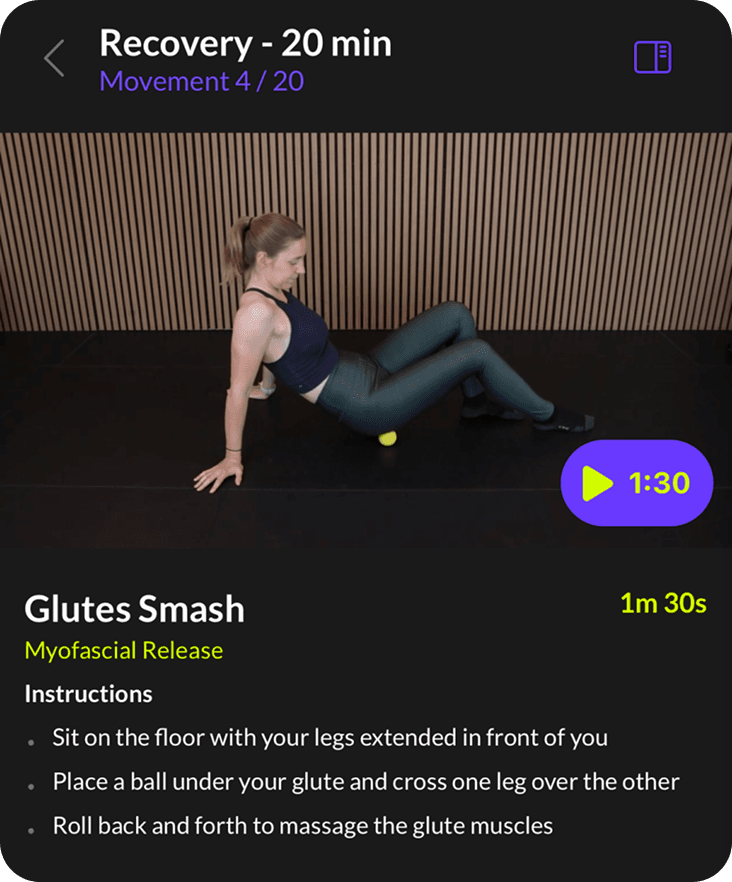
Sleep supports the repair that ends soreness, but it is not a painkiller. Very few studies have measured whether extra sleep makes delayed onset muscle soreness (DOMS) fade faster, and those that exist are small. The honest summary: sleep is the foundation that makes every other recovery method worth doing, while the soreness itself responds better to light movement, massage and foam rolling. Our guides on foam rolling your quads and releasing your glutes with a lacrosse ball show the technique.
Signs that recovery, not just sleep, is the problem
Poor sleep is also a symptom. Restless nights despite feeling exhausted, a resting heart rate that stays high and performance that keeps dropping are classic signs of accumulated fatigue. In that case, more sleep alone won't fix it; the training load has to come down for a while, starting with a deload week. If it has lasted for weeks, read our guide on how long overtraining lasts.
The bottom line
Sleep is not a recovery bonus, it is where much of the repair happens. One sleepless night measurably reduces muscle protein synthesis, and repeated short nights do the same. Aim for 7 to 9 hours, closer to 8 or 9 when you train hard, and protect the nights after your heaviest sessions: caffeine stopped 6 hours before bed, no alcohol, protein in the evening, hard training finished an hour before lights out.
Frequently asked questions
+How many hours of sleep do you need for muscle recovery?
Adults need 7 to 9 hours according to the National Sleep Foundation, and many athletes fall short of 7. If you train hard, aim for the top of that range, and add time in bed on heavy training days and the night after.
+Do muscles grow while you sleep?
Muscle protein synthesis continues overnight, and sleep supports it: in a controlled study, one night without sleep cut it by 18% the following day. Growth comes from training, food and sleep together, not from sleep alone.
+Is one bad night of sleep enough to ruin recovery?
No. A single short night has a modest effect, and the 2021 expert consensus notes that the impact of 1 to 3 nights of partial sleep loss on performance is still unclear. It is repeated short nights that slow repair and raise injury and illness risk.
+Does sleep help with sore muscles?
Sleep supports the repair that ends soreness, but there is little direct evidence that extra sleep makes DOMS disappear faster. Treat it as the foundation, and use light movement and self-massage for the soreness itself.
+Is it bad to train in the evening if I want to sleep well?
Not for most people. A 2019 meta-analysis found evening exercise does not harm sleep overall. The exception is vigorous exercise ending less than an hour before bed, which can delay sleep onset and shorten the night.
Get this routine built from your own training
Log your workouts and Rekup estimates the load on each muscle group, shows when each one is ready again, and builds a recovery routine for the muscles you actually trained, from more than 130 movements.
Try Rekup PRO free for 14 daysFree plan available. Cancel the trial anytime from the store.


This guide is educational and does not replace a diagnosis. If pain is severe, keeps getting worse or comes with the warning signs listed above, see a doctor or a physiotherapist.
Sources
- Lamon S et al. The effect of acute sleep deprivation on skeletal muscle protein synthesis and the hormonal environment. Physiological Reports, 2021.
- Saner NJ et al. The effect of sleep restriction, with or without high-intensity interval exercise, on myofibrillar protein synthesis in healthy young men. The Journal of Physiology, 2020.
- Walsh NP et al. Sleep and the athlete: narrative review and 2021 expert consensus recommendations. British Journal of Sports Medicine, 2021.
- Mah CD et al. The effects of sleep extension on the athletic performance of collegiate basketball players. Sleep, 2011.
- Hirshkowitz M et al. National Sleep Foundation's sleep time duration recommendations: methodology and results summary. Sleep Health, 2015.
- Milewski MD et al. Chronic lack of sleep is associated with increased sports injuries in adolescent athletes. Journal of Pediatric Orthopaedics, 2014.
- Drake C et al. Caffeine effects on sleep taken 0, 3, or 6 hours before going to bed. Journal of Clinical Sleep Medicine, 2013.
- Parr EB et al. Alcohol ingestion impairs maximal post-exercise rates of myofibrillar protein synthesis following a single bout of concurrent training. PLoS One, 2014.
- Res PT et al. Protein ingestion before sleep improves postexercise overnight recovery. Medicine & Science in Sports & Exercise, 2012.
- Stutz J, Eiholzer R, Spengler CM. Effects of evening exercise on sleep in healthy participants: a systematic review and meta-analysis. Sports Medicine, 2019.
- Dattilo M et al. Sleep and muscle recovery: endocrinological and molecular basis for a new and promising hypothesis. Medical Hypotheses, 2011.