
What Is Myofascial Release, and How Long Does It Last?
By the Rekup team · Published November 2, 2026 · 7 min read
Myofascial release is the use of sustained pressure on a muscle and the connective tissue around it, the fascia, to reduce tension and pain and to move more freely. You can do it yourself with a foam roller or a ball. After a single short session, the gain in range of motion lasts roughly 10 to 30 minutes; the effect on post-workout soreness plays out over 24 to 72 hours; lasting mobility gains need weeks of regular rolling.
This article covers self-myofascial release, the kind you do with a roller or a lacrosse ball. Hands-on myofascial release by a therapist is a related practice with its own, more mixed, body of evidence.
What fascia is, and what "release" was supposed to mean
Fascia is the connective tissue that wraps every muscle, groups muscles together and links them to bones and to each other. Some layers are thin and slippery; others, like the fascia on the outside of the thigh or under the foot, are thick and very stiff.
The original idea behind "myofascial release" was mechanical: fascia gets stuck or shortened, and pressure stretches it or frees "adhesions". That is the claim you still read on most product pages. It doesn't hold up well. A mathematical model of human fascia estimated that deforming dense fascia like the fascia lata or plantar fascia by even 1% would take forces far outside the physiological range, much more than a therapist's hands, let alone a foam roller (Chaudhry et al., 2008).
What actually happens when you roll
A 2019 review by Behm and Wilke went through the possible mechanisms and concluded that there is not enough evidence that rollers release fascial restrictions. The term "self-myofascial release" is, in their words, a misnomer. What the evidence does support is a set of less spectacular effects:
- Nervous system effects. Sustained pressure changes how the brain and spinal cord perceive the area. Pain sensitivity drops and muscle tension can ease for a while. This explains why rolling one leg can slightly improve mobility in the other one, which a purely mechanical effect could not.
- Tissue fluid and temperature. Pressure and movement may make the tissue more fluid and less stiff for a short time, a property called thixotropy.
- Local blood flow. Rolling increases blood flow in the area during and shortly after the session.
None of this is a reason not to roll. It changes how you should roll: slowly, at a pressure you can breathe through, with the goal of calming the muscle down rather than crushing it.
How long does myofascial release last?
The honest answer depends on which effect you mean. Here is what the studies measured.
| Effect | How long it lasts | What the research shows |
|---|---|---|
| Range of motion after one short session | About 10 to 30 minutes | Ankle mobility gains had returned to baseline 30 minutes after rolling in a controlled study (Nakamura et al., 2021) |
| Soreness after a hard session | Measured over 24 to 72 hours | Rolling right after and at 24 and 48 hours reduced tenderness and sped up performance recovery after 100 squats (Pearcey et al., 2015) |
| Performance right after rolling | Short term, small | Small gains in sprint and flexibility, no loss of strength (Wiewelhove et al., 2019) |
| Range of motion with regular practice | Lasting, while you keep doing it | Rolling for several weeks gives moderate range-of-motion gains (Konrad et al., 2022) |
The practical consequences are simple. Rolling right before training gives you a window for your warm-up and first sets, not for the whole session. After a brutal workout, one roll is not enough: repeat it on the next days. And if your goal is to squat deeper or get your arms overhead, a five-minute daily habit beats a 30-minute session once a week.
How long and how often to roll
The research gives a fairly clear dose. Benefits for range of motion and recovery appear from about 90 to 120 seconds per muscle in total (Hughes & Ramer, 2019). Below that, it is a warm-up. Far above that, you mostly add discomfort.
- Before training: about 30 seconds per area, moderate pressure, then straight into your warm-up.
- After a hard session: 90 to 120 seconds per loaded muscle, slower, pausing 20 to 30 seconds on tender spots, then again on the following one to two days.
- For mobility: most days of the week, on the areas that limit your positions, combined with active mobility work in the new range.
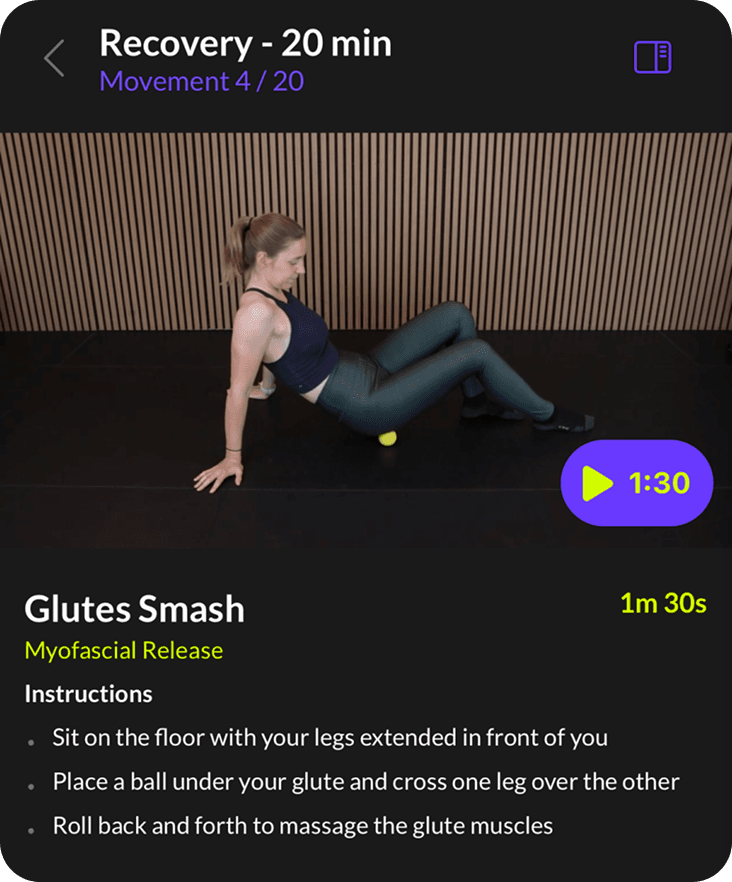
Each area has its own technique details: see the guides on foam rolling your quads, releasing your glutes and piriformis with a lacrosse ball and releasing tight calves.
Foam roller, lacrosse ball or massage gun?
All three apply pressure; they differ in how precise and how heavy that pressure is.
| Tool | Best for | Limits |
|---|---|---|
| Foam roller | Large muscles: quads, calves, hamstrings, upper back | Too broad for the hips, the sole of the foot or between the shoulder blades |
| Lacrosse ball | Precise spots: glutes, piriformis, sole of the foot, pecs, upper back against a wall | Easy to press too hard; avoid bony areas and the front of the neck |
| Massage gun | Quick work on large muscles when getting on the floor isn't practical | Less research behind it than rolling; keep it off bones, joints and the neck |
If you only buy one, a medium-density foam roller covers most needs. Add a lacrosse ball when the glutes and hips are your limiting area, which is common in CrossFit and Hyrox athletes.
What myofascial release can't do
Rolling won't fix a torn muscle, change your posture for good, or replace sleep and sensible training load. Its effect on soreness is real but small: in the meta-analysis, rolling after exercise reduced perceived pain slightly, not dramatically (Wiewelhove et al., 2019). If you are sore for days after every session, the fix is in your programming, and our guide on how to get rid of DOMS explains what actually shortens soreness.
Rolling also doesn't need to hurt to work. Since the effect goes through the nervous system, pressure that makes you tense up and hold your breath works against you.
In short
Self-myofascial release doesn't reshape your fascia. It calms the nervous system's response in the area for a while, which buys you mobility for about half an hour and, when repeated after hard training, a slightly faster recovery. Use it as a short, regular habit: 90 to 120 seconds per loaded muscle, at a pressure you can breathe through, and pair it with movement. If you are wondering whether to stretch as well, read should you stretch after a workout, and for sport-specific plans see how to recover from CrossFit and Hyrox recovery.
Frequently asked questions
+How long does myofascial release last?
After a single short session, the gain in range of motion fades within about 30 minutes in controlled studies. The reduction in soreness after hard training is measured over 24 to 72 hours when you roll after the session and on the following days. Lasting mobility gains come from rolling regularly for several weeks.
+Does myofascial release actually release fascia?
Not in a mechanical sense. Dense fascia needs forces far beyond what a foam roller or your hands can apply to deform permanently. The effects you feel are mostly explained by the nervous system lowering muscle tension and pain sensitivity, plus local changes in blood flow and tissue fluid.
+How long should I hold pressure on a tight spot?
Around 20 to 30 seconds on a tender spot is enough, inside a total of about 90 to 120 seconds per muscle. Holding for minutes at high pressure adds discomfort, not benefit.
+How often should I do self-myofascial release?
Daily is fine. For mobility, consistency over weeks matters more than the length of one session. After a very hard session, rolling right after and on the two following days is the pattern that helped soreness in studies.
+Is myofascial release better than stretching?
For range of motion right after a session, no: a 2022 meta-analysis found no significant difference between one bout of stretching and one bout of foam rolling, immediately or 10 to 20 minutes later. Rolling is often more comfortable on sore muscles, and the two can be combined.
Get this routine built from your own training
Log your workouts and Rekup estimates the load on each muscle group, shows when each one is ready again, and builds a recovery routine for the muscles you actually trained, from more than 130 movements.
Try Rekup PRO free for 14 daysFree plan available. Cancel the trial anytime from the store.


This guide is educational and does not replace a diagnosis. If pain is severe, keeps getting worse or comes with the warning signs listed above, see a doctor or a physiotherapist.
Sources
- Behm DG, Wilke J. Do self-myofascial release devices release myofascia? Rolling mechanisms: a narrative review. Sports Medicine, 2019.
- Chaudhry H et al. Three-dimensional mathematical model for deformation of human fasciae in manual therapy. Journal of the American Osteopathic Association, 2008.
- Nakamura M et al. Acute effects of different foam rolling volumes in the interventions on range of motion, muscle stiffness and strength. Journal of Sports Science and Medicine, 2021.
- Wiewelhove T et al. A meta-analysis of the effects of foam rolling on performance and recovery. Frontiers in Physiology, 2019.
- Konrad A et al. Foam rolling training effects on range of motion: a systematic review and meta-analysis. Sports Medicine, 2022.
- Hughes GA, Ramer LM. Duration of myofascial rolling for optimal recovery, range of motion, and performance. International Journal of Sports Physical Therapy, 2019.
- Pearcey GE et al. Foam rolling for delayed-onset muscle soreness and recovery of dynamic performance measures. Journal of Athletic Training, 2015.
- Konrad A et al. A comparison of a single bout of stretching or foam rolling on range of motion in healthy adults. European Journal of Applied Physiology, 2022.