
Deload Week: When to Take One and How to Do It
By the Rekup team · Published October 29, 2026 · 9 min read
A deload week is a planned week of reduced training, usually cutting volume by about half while keeping the same movements and staying well short of failure, to clear accumulated fatigue before the next block. Most lifters deload every 4 to 8 weeks, but the better trigger is your own signs: stalled lifts, soreness that no longer fades, poor sleep and dread before sessions.
What a deload week is
A deload is a period of reduced training stress. That is the definition a panel of international strength and physique coaches agreed on in a 2023 Delphi consensus: a deload is designed to reduce physical and mental fatigue, promote recovery and prepare you for the training that follows (Bell et al., 2023).
The important word is reduced. A deload is not a week off. You still go to the gym or run, you still squat and pull, but you do less of it and you do it more easily. The goal is to come out of the week fresher without losing the skills and fitness you built.
Deloading is common practice, not a niche idea. In a 2024 survey of 246 competitive strength and physique athletes, every single one of them used deloads. Their deloads lasted about 6 days on average and came roughly every 5.6 weeks, mostly to manage energy and fatigue (Rogerson et al., 2024).
Why fatigue builds up even when you feel fine
Every hard session leaves fatigue behind: sore and slightly damaged muscle, irritated tendons, a nervous system that is less sharp, and a mental cost. Between sessions, most of it clears. Some of it doesn't, and in a well-built program that is on purpose: a few weeks of training slightly above what you can fully absorb is how you push adaptation.
Sports scientists call the short-term version functional overreaching: performance dips for days to a couple of weeks, then rebounds above where it started once you recover. If you keep loading without recovering, it becomes non-functional overreaching, where performance stays down for weeks to months, and in the worst cases overtraining syndrome, a prolonged maladaptation that can take months to resolve (Meeusen et al., 2013).
A deload is the recovery step that turns overreaching into progress. Skip it for too long and the same training starts working against you.
Signs you need a deload
Planned deloads are fine. A deload you take when your body is asking for it is better. These are the signs to watch, from the most to the least reliable:
| Sign | What it looks like | Weight |
|---|---|---|
| Performance stalls or drops | The same weights feel heavier for 2 or more sessions in a row; your easy run pace creeps up at the same effort | Strong |
| Soreness doesn't fade | You start sessions still sore from 2 or 3 sessions ago, in the same muscles | Strong |
| Nagging joint or tendon pain | Elbows, knees, shoulders or Achilles that ache at the start of every warm-up | Strong |
| Sleep gets worse | Trouble falling asleep, waking at night, despite being tired | Medium |
| Motivation drops | You dread sessions you normally enjoy | Medium |
| Resting heart rate is up / HRV is down | Several days in a row outside your usual range | Medium |
| Life stress is high | Exams, a new job, a newborn, travel | Medium (counts as load) |
One sign on its own after a bad night is noise. Two or three strong signs over a week is a good reason to deload now rather than at the end of the block.
How often to deload
There is no rule that fits everyone. The coaches in the Delphi consensus agreed that deload frequency should depend on how the athlete responds to training and on their other commitments, and that deloads can be planned in advance, triggered by how the athlete feels, or both (Bell et al., 2023).
As a starting point:
- Lifting 3 to 4 days a week, moderate volume: you may not need scheduled deloads. Take one when the signs above show up.
- Lifting 4 to 6 days a week or high volume (bodybuilding, powerlifting blocks): every 4 to 6 weeks.
- CrossFit 5 days a week or more: every 5 to 8 weeks, and earlier after a competition or the Open.
- Hyrox and endurance training: a lighter week every 3 to 4 weeks is a common pattern in running plans, plus a deload after every race.
Then adjust. If you get to week 4 and every session is still going up, you can push the deload back a week. If you're dragging by week 3, take it early.
How to deload: the protocol
The Delphi experts agreed on most of the levers: cut volume by doing fewer sets, fewer reps or fewer training days; keep exercise selection familiar, especially the multi-joint lifts; focus on technique; and drop or reduce accessory work. They also agreed that intensity can stay the same while volume goes down (Bell et al., 2023).
For most people, a simple version works:
The volume cut is the part with the most evidence behind it. In a meta-analysis of tapering studies, the best results came from reducing training volume by 41 to 60% over about two weeks while keeping intensity and frequency the same (Bosquet et al., 2007). Tapers are not deloads, but they rely on the same lever: less volume, same intensity, and you stay sharp.
Deload examples for lifting, CrossFit, Hyrox and running
These are examples to adapt, not prescriptions. The principle stays the same across sports: less total work, same movements, lower effort.
| Sport | Normal week (example) | Deload week |
|---|---|---|
| Strength training | Squat 4×5 at 80%, bench 4×6, rows 4×8, 4 accessories | Squat 2×5 at 70 to 80%, bench 2×6, rows 2×8, 1 accessory |
| CrossFit | 5 sessions: strength + metcon, 1 long chipper | 4 sessions: strength at 2 sets, short metcons at 6 to 7/10 effort, no chipper, skill work |
| Hyrox | 3 runs (incl. intervals), 2 station sessions, 1 compromised-run session | 3 easy runs at shorter distance, 1 light station session (half the reps, lighter sled), no compromised run |
| Running | 50 km, 1 interval session, 1 long run of 18 km | 25 to 30 km, 4 to 6 short strides instead of intervals, long run of 10 to 12 km |
For CrossFit and Hyrox, the trap is the conditioning. Doing your strength work at half volume and then going all-out in a metcon is not a deload. Keep the intensity of the conditioning down too, around 6 to 7 out of 10.
Deload week vs a week off
A full week off feels like the most "recovery" you can get. The research suggests it isn't the best default.
In a 2024 randomised trial, 39 trained participants followed a nine-week resistance program. One group trained continuously; the other stopped training entirely for one week in the middle. Muscle growth, power and muscular endurance of the legs ended up similar in both groups, but the continuous group gained a bit more lower-body strength (Coleman et al., 2024). The authors noted that a deload with reduced training, rather than full cessation, may give different results and still needs to be tested.
Our take: stop completely only when there is a reason — you are sick, injured, travelling without access to training, or mentally done with it. Otherwise, a reduced week keeps your technique and strength while letting fatigue clear.
When a deload is not enough
A deload clears normal training fatigue in about a week. If you deload and still feel just as bad, the problem is probably not just training volume. Our guide on how long overtraining lasts explains how to tell overreaching from overtraining syndrome, and how to come back from each.
What to do during a deload week
The training you take out leaves room for recovery that actually builds you back up:
- Sleep more. It is the recovery method nothing replaces. Aim for at least as much as your usual target, ideally more. Our guide on sleep and muscle recovery explains how much athletes need.
- Eat to recover, not to cut. A deload is a bad time to start a diet. Keep protein and carbohydrates at your normal training levels.
- Move lightly. Walks, easy cycling, swimming.
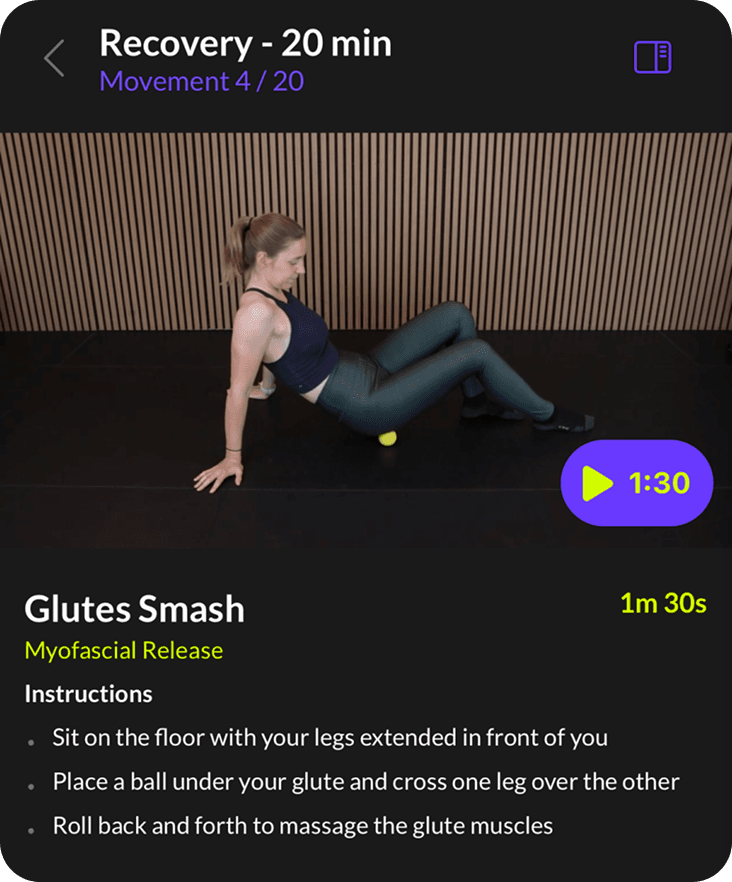
- Work on mobility and soft tissue. Foam roll the muscles you loaded most during the block. Our guides on foam rolling your quads and releasing tight hip flexors work well in a deload week.
- Fix technique. Lighter loads are a good moment to film your lifts and clean up positions.
If your main issue is soreness between hard sessions rather than accumulated fatigue, the methods ranked in how to recover faster between workouts and our DOMS protocol are a better place to start. CrossFit athletes can also read our guide on recovering from CrossFit between WODs and hard weeks.
The bottom line
Take a deload when two or three strong signs line up: stalling performance, soreness that doesn't fade, aching joints. Otherwise, plan one every 4 to 8 weeks depending on how hard and how often you train. Keep the same movements, halve your sets, stay well short of failure, and use the extra time to sleep, eat and move lightly. Stop training completely only when you're sick, injured or burnt out, and see a doctor if a week of deloading doesn't help.
Frequently asked questions
+How often should you take a deload week?
Most strength athletes deload about every 4 to 8 weeks; in a 2024 survey of 246 competitive lifters the average was every 5.6 weeks. Experts agree there is no fixed number: it depends on how you respond to training and what else is loading you, so planned deloads can be moved earlier when fatigue piles up.
+Will I lose muscle or strength during a deload week?
Not from a deload done well. Muscle size does not drop in a week of reduced training. In a 2024 trial, a week of no training at all cost a little lower-body strength compared with training through, which is one reason to reduce sets rather than stop completely.
+Should I stop training completely on a deload week?
Usually not. A deload is reduced training, not a break: keep the same movements, cut sets by roughly half and stay well short of failure. A full week off makes sense when you are sick, injured, or genuinely burnt out from training.
+Do beginners need deload weeks?
Rarely on a schedule. Beginners training three or four times a week with moderate volume recover between sessions, and life tends to provide easy weeks anyway. A deload becomes useful when you train five or more days a week, run high volume, or stack a sport on top of the gym.
+What is the difference between a deload and a taper?
A deload is a recovery week inside a training block, used to shed fatigue before the next block. A taper is a reduction of volume before a competition, often over one to two weeks, to arrive at the event fresh while keeping intensity. They use the same lever, less volume, for different goals.
+Is feeling tired a sign I need a deload or something else?
A few days of fatigue after a hard week is normal and passes with a deload. Fatigue, low mood and falling performance that last for weeks despite rest, or that come with illness, weight loss or sleep problems, are a reason to see a doctor rather than just training less.
Get this routine built from your own training
Log your workouts and Rekup estimates the load on each muscle group, shows when each one is ready again, and builds a recovery routine for the muscles you actually trained, from more than 130 movements.
Try Rekup PRO free for 14 daysFree plan available. Cancel the trial anytime from the store.


This guide is educational and does not replace a diagnosis. If pain is severe, keeps getting worse or comes with the warning signs listed above, see a doctor or a physiotherapist.
Sources
- Bell L, Strafford BW, Coleman M, Androulakis Korakakis P, Nolan D. Integrating deloading into strength and physique sports training programmes: an international Delphi consensus approach. Sports Medicine - Open, 2023.
- Rogerson D, Nolan D, Androulakis Korakakis P, Immonen V, Wolf M, Bell L. Deloading practices in strength and physique sports: a cross-sectional survey. Sports Medicine - Open, 2024.
- Coleman M et al. Gaining more from doing less? The effects of a one-week deload period during supervised resistance training on muscular adaptations. PeerJ, 2024.
- Meeusen R et al. Prevention, diagnosis, and treatment of the overtraining syndrome: joint consensus statement of the European College of Sport Science and the American College of Sports Medicine. Medicine & Science in Sports & Exercise, 2013.
- Bosquet L, Montpetit J, Arvisais D, Mujika I. Effects of tapering on performance: a meta-analysis. Medicine & Science in Sports & Exercise, 2007.