
How to Recover Faster Between Workouts: What the Science Says
By the Rekup team · Published October 23, 2026 · 4 min read
To recover faster between workouts, prioritise sleep (7 to 9 hours), eat about 1.6 g of protein per kg of body weight with enough carbohydrates, keep 48 hours between hard sessions for the same muscle group, and use easy movement, massage or foam rolling on the muscles you trained. Compression and cold water help in specific situations. The biggest gains don't come from a recovery technique, though; they come from planning training load so fatigue never piles up (Kellmann et al., 2018).
Recovery methods ranked by evidence
| Method | Effect | When to use it |
|---|---|---|
| Sleep | Large: strength, repair, mood, injury risk | Every night. Non-negotiable |
| Enough protein and energy | Large, for adaptation and repair | Every day |
| Training load planning | Large, prevents fatigue from accumulating | Every week |
| Massage | Moderate, the most consistent effect on soreness and fatigue | After hard sessions or races |
| Foam rolling | Small to moderate on soreness, no loss of performance | Daily, 60 to 120 s per muscle |
| Active recovery | Small, mostly on perceived soreness | Rest days, cooldowns |
| Compression garments | Small to moderate | Travel, between competition days |
| Cold water immersion | Moderate on short-term soreness, can blunt strength gains | Competitions, not after every strength session |
| Static stretching | Little effect on soreness | For range of motion, not recovery |
Sources: Dupuy et al., 2018; Wiewelhove et al., 2019; Brown et al., 2017; Roberts et al., 2015.
1. Sleep is the recovery method
Most muscle repair and hormonal recovery happens during sleep. Sleep restriction reduces strength, endurance and decision-making, and is linked to a higher injury risk (Fullagar et al., 2015). Practical rules:
- aim for 7 to 9 hours, with a consistent bedtime;
- keep training at least 2 to 3 hours away from bedtime when possible;
- avoid caffeine after early afternoon;
- a 20-minute nap helps after a short night.
2. Eat for recovery
- Protein: about 1.6 g per kg of body weight a day maximises strength and muscle gains (Morton et al., 2018), spread over 3 to 4 meals.
- Carbohydrates: they refill glycogen. If you train hard on consecutive days, they matter as much as protein.
- Energy: eating too little overall is one of the most common causes of slow recovery, especially in athletes trying to lose weight.
3. Plan load so you recover between sessions
Recovery is not just what you do after training. It's the space your program leaves between sessions. Two principles:
- Rotate muscle groups. After a hard session for the legs, the legs need about 48 hours before the next hard session. Upper body, technique or conditioning work can fill the gap.
- Increase load progressively. Injuries are associated with sudden spikes in load compared with what you've been doing in the previous weeks, more than with high training load itself (Gabbett, 2016). Plan a lighter deload week every 4 to 8 weeks, and if fatigue keeps building anyway, our guide on signs of overtraining and how long it lasts helps you decide what to do.
4. Use targeted recovery work on fatigued muscles
Massage has the most consistent evidence for reducing soreness and perceived fatigue (Dupuy et al., 2018). You can't get a massage every day, but you can get most of the benefit at home:
- Foam rolling, 60 to 120 seconds per muscle group, moderate pressure (Wiewelhove et al., 2019). See our guide on foam rolling the quads.
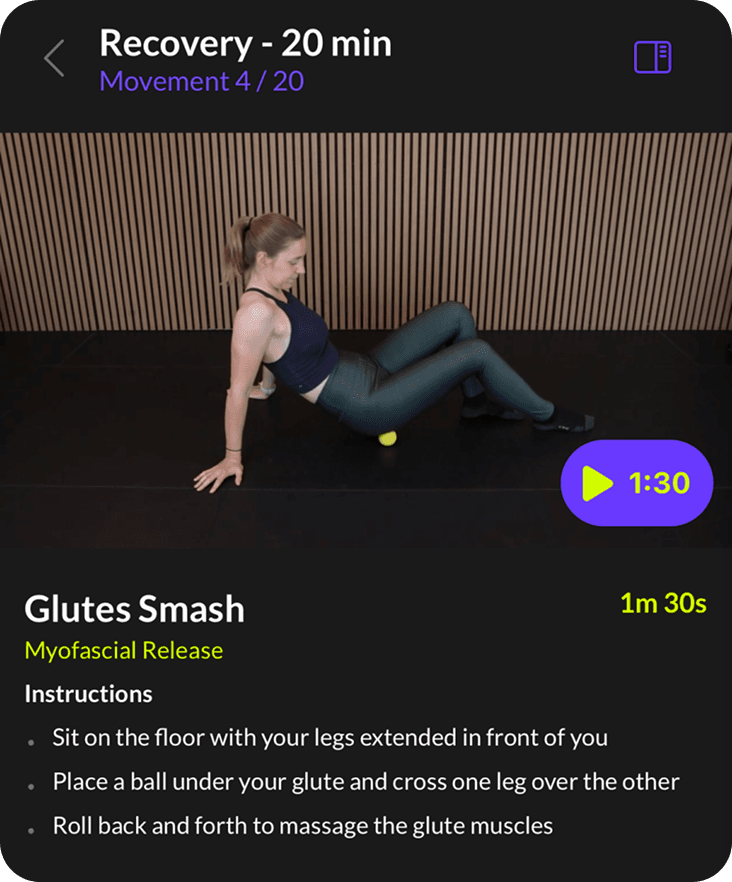
- Lacrosse ball for smaller, deeper areas like the glutes, the piriformis, the calves and the shoulders: glute and piriformis release.
- Mobility for joints that feel stiff after training: hips, ankles, thoracic spine.
The key is targeting: rolling the muscles you trained yesterday is worth more than a generic full-body routine.
5. Active recovery on rest days
20 to 40 minutes of walking, easy cycling or swimming at a conversational pace. It doesn't speed up muscle repair much, but it reduces perceived soreness and stiffness and makes the next session feel better.
6. Compression and cold: use them strategically
Compression works modestly on soreness and the recovery of strength (Brown et al., 2017). Most useful when you travel or sit for hours after a hard session.
Cold water reduces short-term soreness, but used regularly after strength training it blunts strength and muscle gains (Roberts et al., 2015). Keep it for competition days, tournaments, or two sessions on the same day.
Signs you're not recovering
- Performance going down for more than a week.
- Resting heart rate noticeably above your usual baseline, or heart rate variability well below it.
- Poor sleep despite being tired.
- Persistent soreness, aching joints, frequent colds.
- Low motivation and irritability.
If several of these appear together, take an easier week before adding more recovery techniques.
In short
Sleep 7 to 9 hours, eat enough protein and carbohydrates, give each muscle group 48 hours between hard sessions, and increase load progressively. Then add targeted foam rolling, mobility and easy movement for the muscles you trained. Keep cold water and compression for competitions and travel. For soreness specifically, read how to get rid of DOMS.
Frequently asked questions
+What is the fastest way to recover muscles?
Sleep 7 to 9 hours, eat enough protein and carbohydrates, and keep moving gently on rest days. Massage and foam rolling reduce soreness on top of that. No gadget or supplement replaces these basics.
+How long do muscles need to recover between workouts?
After a hard session, a muscle group usually needs around 48 hours before being loaded hard again, and up to 72 hours or more after very high volume or unfamiliar eccentric work.
+Does active recovery work better than rest?
Light movement such as walking, easy cycling or swimming tends to feel better than complete rest and reduces perceived soreness. It should be easy enough that you could hold a conversation.
+Do recovery supplements work?
Protein and creatine have solid evidence for training adaptation. Most other recovery supplements have small or inconsistent effects. Caffeine helps performance, not recovery, and can hurt sleep if taken late.
+Is ice bathing good for recovery?
It reduces soreness in the short term, which is useful during competitions. Used after every strength session, it can blunt muscle and strength gains, so it isn't a good daily habit for most athletes.
Get this routine built from your own training
Log your workouts and Rekup estimates the load on each muscle group, shows when each one is ready again, and builds a recovery routine for the muscles you actually trained, from more than 130 movements.
Try Rekup PRO free for 14 daysFree plan available. Cancel the trial anytime from the store.


This guide is educational and does not replace a diagnosis. If pain is severe, keeps getting worse or comes with the warning signs listed above, see a doctor or a physiotherapist.
Sources
- Dupuy O et al. An evidence-based approach for choosing post-exercise recovery techniques. Frontiers in Physiology, 2018.
- Kellmann M et al. Recovery and performance in sport: consensus statement. International Journal of Sports Physiology and Performance, 2018.
- Fullagar HH et al. Sleep and athletic performance. Sports Medicine, 2015.
- Morton RW et al. Protein supplementation and resistance training-induced gains in muscle mass and strength: a meta-analysis. British Journal of Sports Medicine, 2018.
- Wiewelhove T et al. A meta-analysis of the effects of foam rolling on performance and recovery. Frontiers in Physiology, 2019.
- Brown F et al. Compression garments and recovery from exercise: a meta-analysis. Sports Medicine, 2017.
- Roberts LA et al. Post-exercise cold water immersion attenuates acute anabolic signalling and long-term adaptations in muscle to strength training. Journal of Physiology, 2015.
- Gabbett TJ. The training-injury prevention paradox. British Journal of Sports Medicine, 2016.