
Pliability and GOWOD Alternatives: Best Mobility Apps 2026
By the Rekup team · Published October 23, 2026 · 4 min read
The best mobility apps in 2026 are Rekup, Pliability and GOWOD. Rekup is the best choice if you train hard and want mobility and release work matched to the muscles you trained, without guessing. Pliability (formerly ROMWOD) is the best library of guided follow-along video sessions. GOWOD is the best for testing your mobility and following a program built around your limits. The key difference: Pliability and GOWOD start from your mobility; Rekup starts from your training.
Disclosure: Rekup is our app. We describe the other apps as fairly as we can. Prices change often, so check the store before you subscribe.
Quick comparison
| Rekup | Pliability | GOWOD | |
|---|---|---|---|
| Built around | Your workouts and the muscle load they created | Guided video mobility sessions | A mobility test and your mobility profile |
| How sessions are chosen | Generated for today's fatigued muscles, from 130+ movements | Daily session, programs and a library you browse | Program adapted to your test results |
| Content types | Myofascial release (roller, ball), mobility, activation, blood-flow work | Mostly stretching and mobility, long holds | Mobility, stretching, activation, warm-ups |
| Training load tracking | Yes: body map and Muscle Readiness | No | No |
| Best for | CrossFit, Hyrox, weightlifting, running | People who like follow-along video and yoga-style sessions | Athletes who want to measure and fix mobility limits |
| Free option | Free plan | Free trial | Free tier |
Why "mobility based on your training" matters
Mobility work improves range of motion, whether through stretching or foam rolling (Behm et al., 2016; Wilke et al., 2020), and rolling reduces perceived soreness a little without hurting performance (Wiewelhove et al., 2019). But the effect is local: rolling your thoracic spine does nothing for your calves. So the most useful mobility session is the one aimed at what's tight and loaded today: hips and quads after squats, lats and shoulders after pull-ups and overhead work, calves after running and double-unders.
That's the question each app answers differently: a fixed daily session, a program based on a test, or a routine generated from your training.
1. Rekup: best for mobility and recovery based on your training
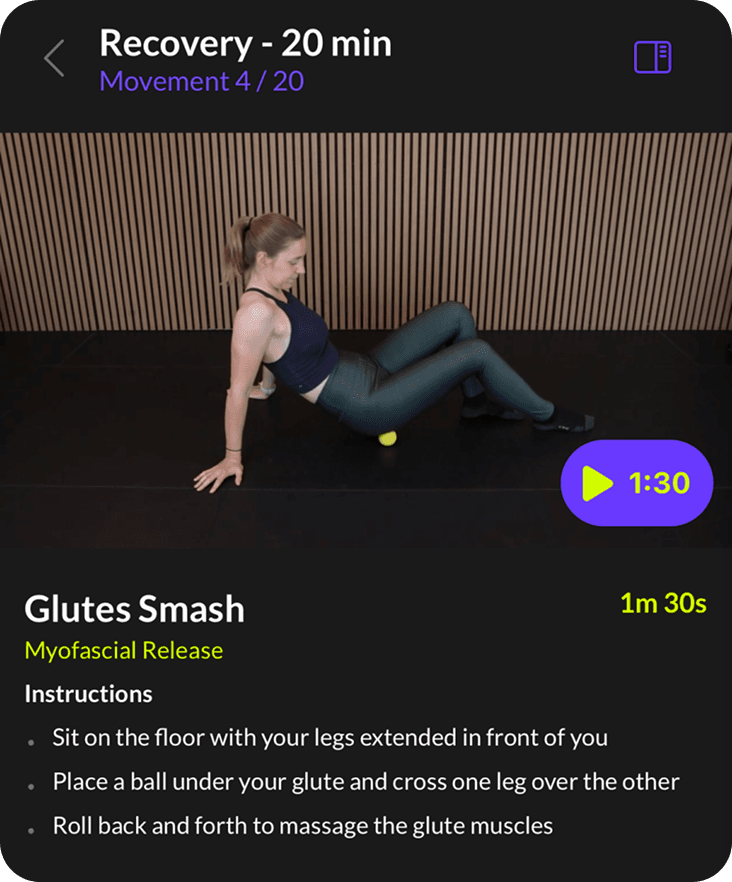
How it works. Log your workout (manually or by scanning the whiteboard or a text). Rekup estimates the load on each muscle group, shows it on a body map, and generates a routine for the muscles that need it: release with a roller or ball, mobility, activation and blood-flow movements, chosen from more than 130 exercises, with a timer and instructions for each.
Strengths.
- No guessing what to work on: the routine follows your training.
- Combines mobility with soft tissue release, which has the most consistent evidence for soreness and recovery.
- Muscle Readiness tells you when to push and when to recover.
- Short routines, easy to fit after a session.
Limits. Not a follow-along video yoga app, and no standalone mobility test.
2. Pliability: best library of guided video sessions
How it works. Pliability, formerly ROMWOD, offers guided video sessions: a daily session, programs for specific goals and sports, and a large library you browse by body area, duration or sport. It includes a mobility assessment and connects with some wearables.
Strengths. High-quality videos, lots of choice, calm and easy to follow. Good for people who like to press play and follow along, often before bed.
Limits. Sessions don't adapt to the training you just did; you pick them. Sessions rely mostly on longer stretching holds, with less soft tissue release work.
Price: subscription after a free trial, around $17.95 a month or $179 a year at the time of writing.
3. GOWOD: best mobility assessment
How it works. GOWOD, built with CrossFit athletes in mind, starts with a mobility test that scores different areas of your body, then builds a program around your weakest points. It also offers pre-workout and post-workout sessions, plus a video library.
Strengths. The assessment is motivating: you see your mobility improve over time. Good for athletes with a specific limit, like an overhead squat or a front rack position.
Limits. The program is based on your mobility profile, not on the muscle load from your recent training.
Price: free tier with the assessment and library; Premium for personalized programs, with a free trial.
Which mobility app should you choose?
- You train 4 to 6 times a week and want to recover between sessions: Rekup.
- You want a relaxing, follow-along stretching habit: Pliability.
- You have a specific mobility limit to fix (overhead, ankle, hips): GOWOD.
They're not mutually exclusive. A common combination is GOWOD or Pliability for long-term mobility goals, and Rekup for day-to-day recovery after training.
Get the most out of any mobility app
- Short and frequent beats long and rare. 10 minutes, most days.
- Target what you trained. After squats, see how to recover from squats; after runs, how to release tight calves.
- Keep long static holds away from explosive work. Dynamic mobility before, longer holds after.
- Add strength at end range. Mobility gained without strength fades quickly. See how to release tight hamstrings for an example.
In short
Pliability is the best follow-along video library, GOWOD the best mobility test and program, and Rekup the best if you want mobility and release work that follows your training and tells you when your muscles are ready. If you train hard several times a week, start with Rekup: download it free.
Frequently asked questions
+What is the best mobility app?
For athletes who want mobility and recovery work based on what they actually trained, Rekup. For a large library of guided follow-along videos, Pliability. For a mobility assessment and a program built around your mobility limits, GOWOD.
+Is Pliability the same as ROMWOD?
Yes. ROMWOD, a mobility app popular in CrossFit, was rebranded as Pliability and broadened to more sports and everyday users.
+What's the difference between Pliability and GOWOD?
Pliability is built around guided video sessions you follow along with. GOWOD is built around a mobility test that identifies your limits and adapts your program to them. Both focus on mobility rather than on the training you just did.
+Is there a free mobility app?
GOWOD has a free tier that includes its mobility assessment and video library. Pliability offers a free trial. Rekup is free to download; check the store listing for what's included in your country.
+How often should I do mobility work?
Short daily sessions of 10 to 15 minutes are more effective and easier to keep up than one long weekly session. Target the joints and muscles your sport and your last workouts loaded most.
Get this routine built from your own training
Log your workouts and Rekup estimates the load on each muscle group, shows when each one is ready again, and builds a recovery routine for the muscles you actually trained, from more than 130 movements.
Try Rekup PRO free for 14 daysFree plan available. Cancel the trial anytime from the store.


This guide is educational and does not replace a diagnosis. If pain is severe, keeps getting worse or comes with the warning signs listed above, see a doctor or a physiotherapist.
Sources
- Behm DG et al. Acute effects of muscle stretching on physical performance, range of motion, and injury incidence: a systematic review. Applied Physiology, Nutrition, and Metabolism, 2016.
- Wilke J et al. Acute effects of foam rolling on range of motion in healthy adults: a systematic review with multilevel meta-analysis. Sports Medicine, 2020.
- Wiewelhove T et al. A meta-analysis of the effects of foam rolling on performance and recovery. Frontiers in Physiology, 2019.
- Pliability. Mobility and stretching app.
- GOWOD. Pricing and features.