
The Best Muscle Recovery Apps for Runners in 2026
By the Rekup team · Published October 23, 2026 · 4 min read
The best muscle recovery apps for runners in 2026 are Rekup (muscle-level load, Muscle Readiness and targeted recovery routines for calves, quads, hamstrings and hips), Garmin Connect (Training Readiness and HRV if you run with a Garmin), Whoop (24/7 sleep and HRV tracking), Runna (adaptive training plans) and Strava (training log and load trends). For most runners, the strongest combination is a watch for tracking runs and Rekup for muscle recovery, especially if you also do strength training.
Disclosure: Rekup is our app. We describe the other apps as fairly as we can. Prices change, so check the store.
What runners actually need from a recovery app
Running injuries are mostly load problems: mileage, speed or hills increasing faster than muscles and tendons adapt (Gabbett, 2016). A useful recovery app should help with three things:
- Seeing load build up, not just total mileage but which tissues take it: calves after speed work, quads after downhill races.
- Knowing when you're ready for the next hard session, through heart rate variability, muscle load or both (Plews et al., 2013).
- Doing the right recovery work: rolling and mobility for the muscles you loaded, which reduces perceived soreness without hurting performance (Wiewelhove et al., 2019).
Quick comparison
| App | Best for | Muscle-level recovery | Readiness | Recovery routines |
|---|---|---|---|---|
| Rekup | Runners who also lift, race recovery, recurring tightness | Yes | Muscle Readiness per muscle group | Yes, personalized |
| Garmin Connect | Garmin watch owners | No | Training Readiness, HRV status, recovery time | No |
| Whoop | Sleep and HRV tracking | No | Daily recovery score | No |
| Runna | Structured plans for 5K to marathon | No | Plan adapts to completed sessions | Strength and mobility sessions in plans |
| Strava | Logging and community | No | Load and fitness trends (subscription) | No |
1. Rekup: best for muscle recovery
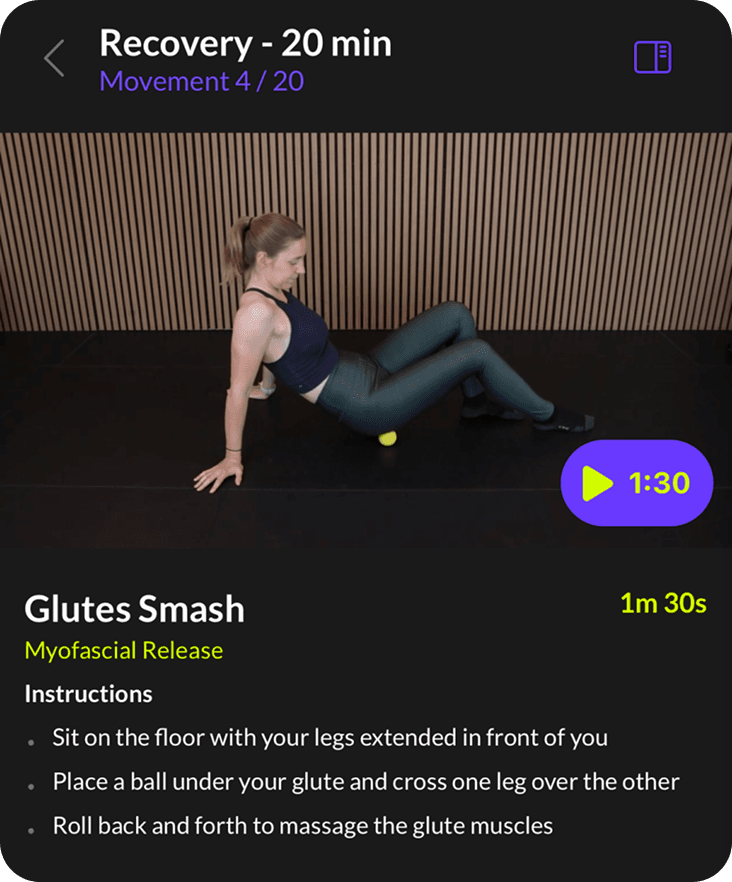
Your watch tells you that you ran 15 km at threshold; Rekup tells you that your calves and hamstrings took most of it and won't be ready for hills until Thursday. Log your runs and strength sessions, and Rekup estimates the load on each muscle group, shows a body map and a Muscle Readiness score, and builds recovery routines for the muscles you loaded: calf and soleus release, quad and hip flexor mobility, glute activation, with a timer and instructions for each movement.
Why runners like it: it covers the strength and mobility side most running apps ignore, and it's especially useful after races, when you feel fine long before your muscles are repaired (Warhol et al., 1985).
Limits: it doesn't analyse pace, GPS or heart rate; keep your watch for that.
Price: free plan; Rekup PRO with a 14-day free trial.
2. Garmin Connect: best for runners with a Garmin
Compatible Garmin watches combine sleep, HRV status and recent training load into a Training Readiness score, with Body Battery and a recommended recovery time after each run. The core recovery features don't need an extra subscription.
Limits: global, not muscle-specific, and less accurate for strength training sessions.
3. Whoop: best for sleep and HRV
The Whoop strap tracks HRV, resting heart rate and sleep around the clock and gives a daily recovery score. Particularly useful for runners whose limiting factor is sleep, stress or travel.
Limits: no running-specific metrics like pace or GPS without a phone, and no muscle-level guidance. Membership required.
4. Runna: best for adaptive training plans
Runna, now part of Strava, builds structured plans for 5K to marathon with pace targets, and adjusts future sessions based on what you complete. Plans include strength and mobility sessions alongside the running.
Limits: it's a coach, not a recovery tracker: it doesn't measure how fatigued your muscles are.
5. Strava: best training log
Strava is the reference for logging runs and community. Subscribers get training load and fitness trends.
Limits: no recovery guidance as such.
The best setup for runners
- Track runs with your watch and Strava.
- Check readiness: Garmin or Whoop for overall readiness, Rekup for your legs.
- Recover with intent: after each hard session, do the 10-minute Rekup routine for the muscles you loaded.
- After races, follow a structured plan: how to recover from a marathon.
For recurring tightness, see how to release tight calves, tight hamstrings and tight hip flexors.
In short
Garmin, Whoop, Runna and Strava are great at tracking runs, sleep and plans. None of them tells you which muscles are still loaded or what to do about it. Rekup does, and it's the missing recovery layer for runners, especially those who also lift. Download Rekup free.
Frequently asked questions
+What is the best recovery app for runners?
Rekup is the best app for muscle recovery: it shows which muscles your runs loaded and gives you routines for calves, quads, hamstrings and hips. For recovery based on heart rate variability, use Garmin Connect if you own a Garmin, or Whoop.
+Do runners need a recovery app?
Not strictly, but most running injuries come from load increasing faster than the body adapts. An app that tracks load and recovery makes those increases visible before they turn into pain.
+Does Strava track recovery?
Strava shows training load and fitness trends for subscribers, but it doesn't give muscle-level recovery guidance. Pair it with a recovery app.
+Can Rekup be used with Garmin or Strava?
Yes, they're complementary: keep your watch and Strava for tracking runs, and use Rekup for muscle load, Muscle Readiness and recovery routines, especially if you also do strength training.
+What muscles should runners focus on for recovery?
Calves and the soleus, quads, hamstrings, glutes and hip flexors. Downhill running and races load the quads most; speed work and hills load the calves and hamstrings.
Get this routine built from your own training
Log your workouts and Rekup estimates the load on each muscle group, shows when each one is ready again, and builds a recovery routine for the muscles you actually trained, from more than 130 movements.
Try Rekup PRO free for 14 daysFree plan available. Cancel the trial anytime from the store.


This guide is educational and does not replace a diagnosis. If pain is severe, keeps getting worse or comes with the warning signs listed above, see a doctor or a physiotherapist.
Sources
- Gabbett TJ. The training-injury prevention paradox. British Journal of Sports Medicine, 2016.
- Plews DJ et al. Training adaptation and heart rate variability in elite endurance athletes. Sports Medicine, 2013.
- Warhol MJ et al. Skeletal muscle injury and repair in marathon runners after competition. American Journal of Pathology, 1985.
- Wiewelhove T et al. A meta-analysis of the effects of foam rolling on performance and recovery. Frontiers in Physiology, 2019.
- Garmin. Training Readiness and recovery features.
- Runna. Personalised running plans.
- WHOOP.