
How to Recover From a Marathon: A Week-by-Week Plan
By the Rekup team · Published October 23, 2026 · 5 min read
To recover from a marathon, walk instead of running for the first 3 days, start easy runs between day 4 and day 7, and keep intervals and long runs out of your plan for 3 to 4 weeks. Soreness fades within a few days, but muscle repair doesn't: in biopsies of marathon runners, fibre damage was still being repaired 3 to 4 weeks after the race (Warhol et al., 1985). Sleep, food and easy movement do most of the work; massage, compression and cold water add a little on top.
What a marathon does to your body
A marathon is around 30,000 to 40,000 foot strikes, each landing with two to three times your body weight. Three things need to recover, and they don't recover at the same speed.
| What's affected | What happened | Typical recovery time |
|---|---|---|
| Muscle fibres (quads, calves, glutes) | Microscopic damage from repeated eccentric loading, worse on downhills | Soreness 3 to 5 days, repair 3 to 4 weeks |
| Energy stores | Glycogen used up, often completely | 24 to 48 hours with enough carbohydrates |
| Tendons and bones | Repeated impact on the Achilles, shins, feet | Several weeks, without pain as a warning |
| Nervous and immune systems | General fatigue, poorer sleep, more colds | 1 to 2 weeks |
This is why the classic mistake is coming back too early: by day 5 your legs feel fine, but the tissue is still remodelling. The runners who pick up an injury after a marathon are usually those who raced again, or ran intervals, in the first two weeks.
The first 48 hours
Week-by-week marathon recovery plan
Week 1: rest and move.
- Days 1 to 3: walking, easy cycling or swimming, 20 to 40 minutes. Gentle foam rolling of quads and calves, 60 to 90 seconds per area.
- Days 4 to 7: a first run of 20 to 30 minutes at a very easy pace, only if you can run without limping or changing your stride. If not, wait another two days.
Week 2: easy running only.
- 3 or 4 easy runs of 30 to 45 minutes. No watch-pace targets: run by feel.
- Light strength work for hips, glutes and calves, without heavy eccentric loading.
- Mobility for hips and ankles.
Week 3: rebuild.
- Bring back a longer easy run, around 60 to 75 minutes.
- Add short strides at the end of easy runs to test your legs.
- Full strength sessions, with progressive leg loading.
Week 4: back to structure.
- First interval or tempo session, shorter than usual.
- A long run back at about 75% of your peak training distance.
- Race again only from week 6 to 8 for a short race, and later for another marathon.
What actually helps, and what doesn't
Sleep and food come first. Nothing you can buy beats them. Sleep loss slows muscle repair and increases the risk of illness after a race, a time when many runners catch a cold.
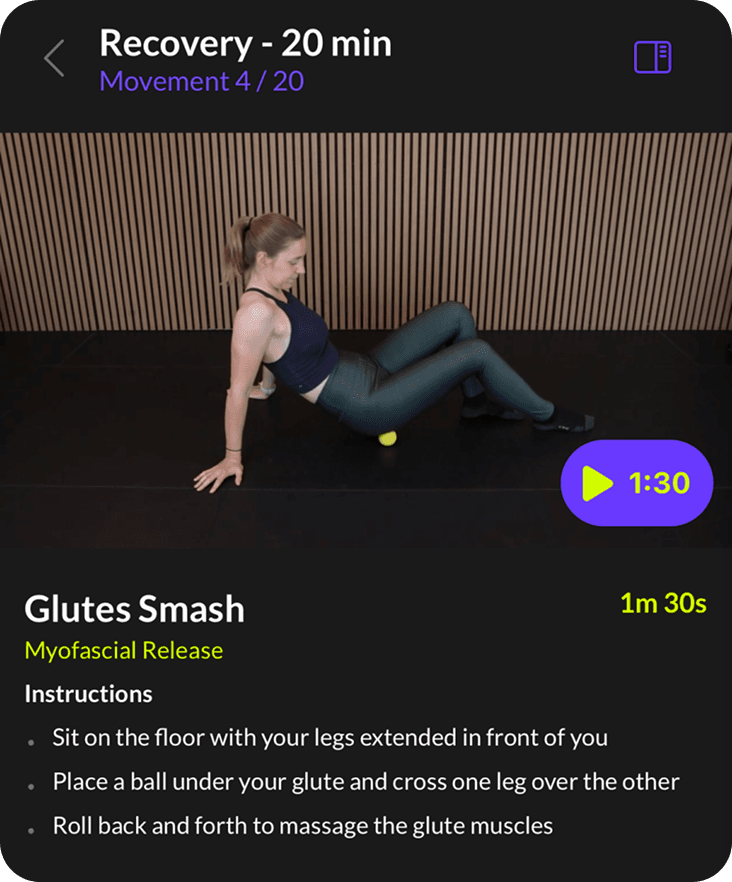
Massage: yes, from day 2 or 3. Massage has the most consistent effect on soreness among recovery techniques (Dupuy et al., 2018). Choose a light sports massage, not a deep one, in the first week. Foam rolling is the at-home version: our guide on foam rolling your quads explains how long and how hard.
Stretching: gentle, if you enjoy it. Stretching doesn't reduce soreness much, but light mobility for the hips, calves and ankles helps you move normally again. For the areas that stay tight after a race, see how to release tight calves and how to release tight hip flexors.
Anti-inflammatories: not as a habit. They can mask a real injury and are best avoided in the days after an endurance race, when your kidneys are already under stress.
Signs you need more time
Your heart rate and sleep are better guides than the calendar. Give yourself more easy days if you notice:
- a resting heart rate noticeably above your usual baseline in the morning, or a heart rate variability well below it (Plews et al., 2013);
- easy runs that feel hard, with heavy, flat legs;
- poor sleep despite feeling tired;
- low motivation, irritability or a cold that doesn't go away.
In short
Days 0 to 3: walk, eat, sleep, compression and cold water if you want. Days 4 to 7: a first very easy run if your stride is normal. Week 2: easy running only. Week 3: build back the long run. Week 4: first intervals. Muscles feel fine long before they are fully repaired, so let your heart rate, sleep and legs, not the calendar, decide your first hard session. For the general picture on soreness, read how to get rid of DOMS.
Frequently asked questions
+How long does it take to recover from a marathon?
Soreness usually fades within 3 to 5 days, but muscle repair takes much longer: biopsy studies found fibre damage still being repaired 3 to 4 weeks after the race. Most runners return to easy running in week 1 or 2 and to hard sessions in week 3 or 4.
+Should I run the day after a marathon?
No. Walk instead. Running on damaged muscles adds load without speeding up repair. Walking, easy cycling or swimming for 20 to 30 minutes gives you the blood flow without the impact.
+Is the old rule of one easy day per mile still valid?
It is a reasonable upper limit for hard training: 26 days before races and intervals. Easy runs can come back much sooner, usually from day 4 to 7, as long as your stride is normal.
+Why do my legs hurt more going downstairs after a marathon?
Going downstairs makes your quads work eccentrically, lengthening under load, which is exactly the type of contraction that was damaged during the race, especially on the downhills.
+Should I take an ice bath after a marathon?
It's a reasonable choice on race day and the day after. Cold water reduces soreness in the short term. The concern that it blunts training adaptations matters for regular training, not after a race.
Get this routine built from your own training
Log your workouts and Rekup estimates the load on each muscle group, shows when each one is ready again, and builds a recovery routine for the muscles you actually trained, from more than 130 movements.
Try Rekup PRO free for 14 daysFree plan available. Cancel the trial anytime from the store.


This guide is educational and does not replace a diagnosis. If pain is severe, keeps getting worse or comes with the warning signs listed above, see a doctor or a physiotherapist.
Sources
- Warhol MJ, Siegel AJ, Evans WJ, Silverman LM. Skeletal muscle injury and repair in marathon runners after competition. American Journal of Pathology, 1985.
- Dupuy O et al. An evidence-based approach for choosing post-exercise recovery techniques. Frontiers in Physiology, 2018.
- Brown F et al. Compression garments and recovery from exercise: a meta-analysis. Sports Medicine, 2017.
- Fullagar HH et al. Sleep and athletic performance. Sports Medicine, 2015.
- Roberts LA et al. Post-exercise cold water immersion attenuates acute anabolic signalling and long-term adaptations in muscle to strength training. Journal of Physiology, 2015.
- Plews DJ et al. Training adaptation and heart rate variability in elite endurance athletes. Sports Medicine, 2013.
- MedlinePlus. Rhabdomyolysis.