
The Best Muscle Recovery Apps for Weightlifting in 2026
By the Rekup team · Published October 23, 2026 · 4 min read
The best muscle recovery apps for weightlifting in 2026 are Rekup (load per muscle group, Muscle Readiness and recovery routines for the muscles you trained), Fitbod (workout generator that takes muscle recovery into account), Hevy and Strong (the best lifting logs), and Whoop (sleep and HRV). If your goal is to recover faster between sessions and avoid nagging overuse pain, Rekup is the app built for that. If you want an app to write your program, Fitbod.
Disclosure: Rekup is our app. We describe the other apps as fairly as we can. Prices change, so check the store.
What lifters need from a recovery app
Strength training recovery is local: after heavy squats your quads and glutes need 48 to 72 hours, while your upper body is ready the next day. Progress comes from loading muscles again once they've recovered, progressively, without sudden spikes in volume (Gabbett, 2016). Recovery basics are sleep and protein, about 1.6 g per kg of body weight a day (Morton et al., 2018). An app helps on top of that by:
- showing which muscle groups are still loaded;
- telling you when to push and when to back off;
- guiding targeted recovery work, like rolling, which reduces soreness without hurting performance (Wiewelhove et al., 2019).
Quick comparison
| App | Best for | Muscle-level recovery | Generates workouts | Recovery routines |
|---|---|---|---|---|
| Rekup | Recovering between sessions | Yes: body map + Muscle Readiness | No, you follow your own program | Yes, personalized from 130+ movements |
| Fitbod | Auto-generated programs | Yes, recovery shown per muscle to build workouts | Yes | No |
| Hevy | Logging, community | Muscle group stats | Routines you build | No |
| Strong | Simple, fast logging | Basic | Routines you build | No |
| Whoop | Sleep and HRV | No | No | No |
1. Rekup: best for muscle recovery
How it works. Log your session manually or by scanning a screenshot or text. Rekup estimates the load on each muscle group, factoring in volume and intensity, and accumulates it over the days on a body map. The Muscle Readiness score tells you whether today is a day to push or to recover.
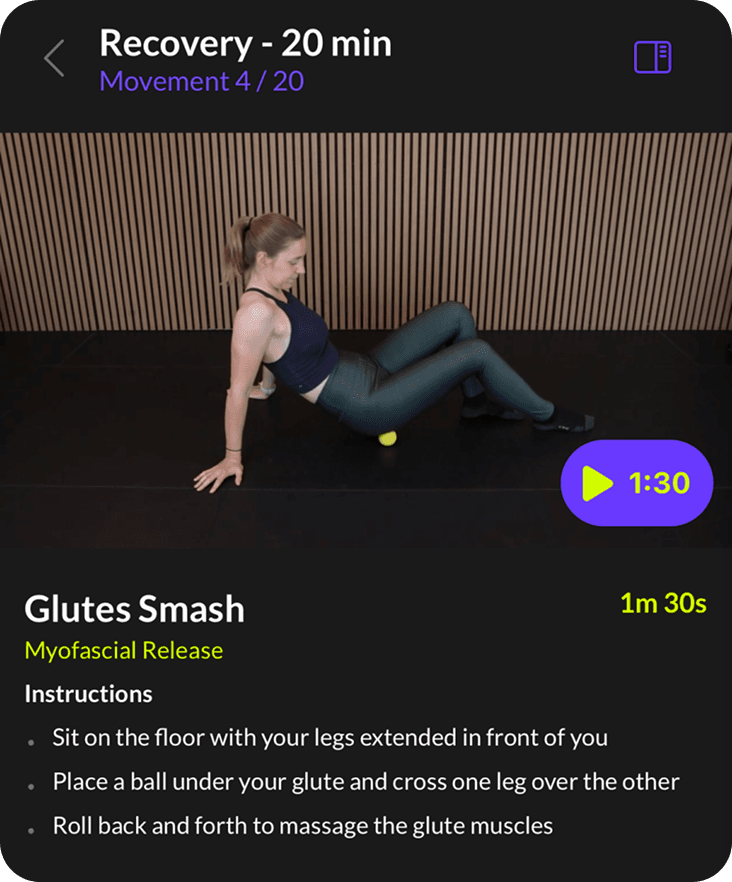
Recovery routines. After a session, Rekup builds a routine for the muscles you trained: glute and quad release after squats, hamstring and lower back work after deadlifts, lat and thoracic mobility after pulling and overhead work, chosen from more than 130 movements with a timer for each.
Why lifters like it: you keep your own program, from your coach, a spreadsheet or another app, and add the recovery layer on top.
Limits: it doesn't generate strength programs or predict 1RMs.
Price: free plan; Rekup PRO with a 14-day free trial.
2. Fitbod: best workout generator
Fitbod builds your workouts automatically, using your history and a recovery estimate for each muscle to choose what to train next.
Limits: it's built for its own generated workouts; if you follow a coach's program, much of its value is lost. No recovery routines.
3. Hevy: best logging app with community
A fast, well-designed workout log with progress charts, muscle group statistics and a social feed.
Limits: it tracks what you did, not how recovered you are.
4. Strong: best minimal log
Simple, fast logging, popular for years with powerlifters.
Limits: no recovery features as such.
5. Whoop: best for sleep
Good for monitoring sleep and general fatigue, which matter a lot for strength. Heart rate-based strain underestimates heavy lifting sets.
The best setup for lifters
- Log in Hevy, Strong or directly in Rekup.
- Check Muscle Readiness in Rekup before heavy days. If your quads are still loaded, swap the order of sessions.
- After training: the 10-minute Rekup routine for the muscles you trained.
- Skip daily ice baths: they blunt strength and muscle gains (Roberts et al., 2015).
For leg day and pulling days, read how to recover from squats and lower back pain after deadlifts. For tight hamstrings after RDLs, see how to release tight hamstrings.
In short
Hevy and Strong log your lifts, Fitbod writes your workouts, Whoop watches your sleep. Rekup is the one built for muscle recovery: what each muscle took, when it's ready, and the routine that helps it recover. Download Rekup free.
Frequently asked questions
+What is the best muscle recovery app for weightlifting?
Rekup is the best app focused on muscle recovery: it estimates load per muscle group, gives a Muscle Readiness score and builds recovery routines for the muscles you trained. Fitbod is the best if you want an app that generates your workouts and adjusts them to recovery. Hevy and Strong are the best pure lifting logs.
+Does Hevy or Strong track muscle recovery?
They're excellent workout logs with progress tracking and muscle group statistics, but they don't focus on recovery guidance. Many lifters log in Hevy or Strong and use Rekup for recovery.
+How long should a muscle recover between lifting sessions?
Around 48 hours after a hard session for the same muscle group is a good default, more after very high volume, new exercises or heavy eccentric work like Romanian deadlifts.
+Are ice baths good for weightlifters?
Not as a routine. Regular cold water immersion after strength training reduces gains in muscle and strength. Keep it for competition days.
+Is Whoop useful for strength training?
Whoop is useful for sleep and overall recovery. Heart rate-based strain underestimates heavy, short lifting sets, so it's less precise for strength training than for endurance.
Get this routine built from your own training
Log your workouts and Rekup estimates the load on each muscle group, shows when each one is ready again, and builds a recovery routine for the muscles you actually trained, from more than 130 movements.
Try Rekup PRO free for 14 daysFree plan available. Cancel the trial anytime from the store.


This guide is educational and does not replace a diagnosis. If pain is severe, keeps getting worse or comes with the warning signs listed above, see a doctor or a physiotherapist.
Sources
- Morton RW et al. Protein supplementation and resistance training-induced gains in muscle mass and strength: a meta-analysis. British Journal of Sports Medicine, 2018.
- Roberts LA et al. Post-exercise cold water immersion attenuates acute anabolic signalling and long-term adaptations in muscle to strength training. Journal of Physiology, 2015.
- Gabbett TJ. The training-injury prevention paradox. British Journal of Sports Medicine, 2016.
- Wiewelhove T et al. A meta-analysis of the effects of foam rolling on performance and recovery. Frontiers in Physiology, 2019.
- Fitbod.
- Hevy.